



Scaling customer support takes more than adding headcount. Learn how growing teams maintain quality, visibility, and control as volume increases.
Customer support can look like it’s scaling smoothly — tickets move quickly, queues stay under control, and response times improve. But behind every complex B2B request, the workload expands. More context, more cross-functional coordination, and more follow-ups create more chances for information to slip through the cracks.
Meanwhile, customer expectations rise. What counted as exceptional last year is now the baseline, and support leaders have to absorb that pressure without stretching their teams too thin or letting quality slide.
This guide covers what scaling customer support takes, with the strategies and metrics that matter most.
What scaling customer support means
Scaling customer support means handling more customers, and the resulting surge in inquiries, without letting service quality slip or putting extra strain on your team.
How you scale customer support depends on both your people and your systems. Strike the right balance between people who can own and resolve complex conversations, and tools like automation and self-service that handle repeatable tasks. Together, they keep every interaction accurate and accounted for, no matter how much demand grows.
Why support breaks when volume adds complexity
More customer requests aren’t the real problem. The real problem is how much extra work each request creates.
B2B companies routinely spend three hours coordinating for every hour they spend resolving issues, including sharing context, navigating handoffs, chasing updates, and keeping stakeholders aligned. As volume climbs, that coordination burden compounds faster than teams can respond. Small gaps snowball into delays and missed expectations, and operational friction shows up fast.
Rising intake drags response times
As inquiries stack up, teams get pulled between moving faster and giving every question the attention it deserves.
The result: support teams start their day with manageable inboxes and end it chasing unanswered questions and urgent escalations. Response times gradually climb, and customers feel the impact through slower resolutions and inconsistent support.
Context fragments across channels
Customer queries rarely stay in one place. A conversation starts in email, jumps to chat, escalates to a call, and pulls in another team before it’s resolved.
Every time that happens in a different tool, the context splinters and support teams end up stitching it back together just to understand what’s going on. What starts as a simple channel hop turns into a break in continuity, eroding trust and dragging out resolution times.
Consistency slips across teams
As support teams grow, keeping service quality consistent gets harder, especially when systems and workflows don’t scale alongside headcount. Without shared processes and clear expectations, teams start solving similar issues in different ways, creating uneven experiences and eroding trust. Eventually, the organization stops trusting its own ability to scale.
4 customer support best practices for visibility across work
Scaling customer support teams need systems that make the effort behind every request visible. Here’s the foundation that keeps teams aligned as volume grows.
1. Launch self-service for recurring issues
Every repetitive question steals time from the work that moves customers forward. Left unchecked, the team ends up copying and pasting answers instead of solving the complex, urgent problems your highest-value accounts need solved.
Self-service tools like knowledge bases, resource centers, interactive product tours, and onboarding checklists change that dynamic. They give customers instant, consistent answers to common questions, cutting unnecessary volume and freeing your team to focus where real expertise is needed.
2. Use AI and automation for routine tasks
Routine work isn’t going anywhere. Every ticket still needs to be categorized, tagged, routed, and assigned. But your team shouldn’t spend their day doing it manually.
Scaling customer support with AI and automation means offloading repetitive work while analyzing intent and sentiment behind every request. What’s the payoff? Questions land with the right person at the right time, prioritizing accuracy and context over speed for its own sake.
3. Create decisive routing and escalation workflows
Visibility alone doesn’t keep work moving. When messages don’t get routed or escalated on time, critical issues get buried under lower-value work. Customers end up waiting longer, repeating details, and chasing updates that should have happened automatically.
Strong routing and escalation workflows fix that — critical issues get prioritized, and every team gets a clear path forward.
4. Maintain continuity across channels
Disconnected conversations create disconnected work. Every handoff requires someone to rebuild context. Teams waste time tracking down information customers have already shared, and simple requests turn into slow, fragmented experiences.
When conversations stay connected, context moves with the work. Anyone can step in at any point and deliver the same experience the customer was promised at the first touchpoint.
Customer metrics to track as you scale
Scaling support is also about understanding how your operation holds up as demand grows. These four metrics reveal where your customer service software is holding steady, and where it starts to strain:
Response time: Response time measures how long it takes your team to reply to a customer, on average. It’s closely tied to customer satisfaction (CSAT) because it’s a direct signal of how accessible support still feels as more requests hit the inbox. Rising response times are an early warning that operational efficiency is slipping.
Resolution time: Resolution time is the average time it takes to completely close a ticket. It reflects the quality and completeness of the support — if customers have to jump through hoops to get an answer, the system is falling short, and that becomes more visible as the volume grows.
Backlog or queue depth: Backlog or queue depth shows how many unsolved tickets are sitting in the inbox. Inbox zero becomes harder to achieve as you scale, but a piling backlog is usually a sign of a processing bottleneck that will eventually affect response and resolution times.
CSAT score: CSAT score measures how customers perceive their support experience from first touch to final resolution. As you scale, more frequent CSAT check-ins (via surveys or social monitoring) help spot where the experience breaks and whether the team is meeting rising expectations.
Scaling support stays in sync with Front
Where does your team spend the most time? For most B2B teams, it isn’t any single task. It’s the effort required to connect them. As complexity rises, that coordination becomes the bottleneck. Every handoff adds friction, every missing detail sends someone back to retrace steps, and every interaction gets harder to manage the moment teams and systems fall out of sync.
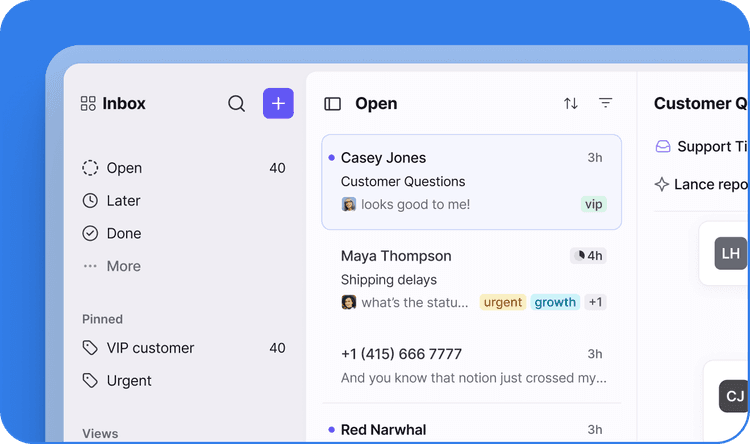
Front changes that. Built for B2B complexity, Front keeps work connected from start to finish. Conversations across every channel stay in sync, context moves with each handoff, and the right people always have the information they need to act quickly and confidently.
See how Front helps teams retain control as support volume grows. Explore Front today.
FAQ
When does outsourcing customer support make sense?
Outsourcing makes sense when long wait times and coordination challenges start affecting the customer experience. A strong partner cuts the delays and keeps conversations connected.
What should support leaders look for in customer support software?
Focus on capabilities that enhance the customer experience while helping teams manage repetitive and complex requests. When evaluating customer support software, look for AI and automation, ticketing systems, a shared workspace for reps, workflow integrations, and tools that make internal collaboration easier.
How often should support teams review their support processes?
Quarterly or semi-annual reviews help teams stay ahead of challenges. Pair these with weekly operational check-ins and updates triggered by major changes, like new product launches or shifts in volume, to continuously adapt and scale sustainably.