




Learn what a customer self-service portal is, which features matter, and how leading platforms help customers find answers and resolve issues on their own.
Customers want self-service to be simple — sign in, get an answer, move on. Behind the scenes, it rarely is.
It requires a tightly coordinated operation where knowledge and workflows move in lockstep. When information is outdated or workflows aren’t aligned, customers lose trust and teams lose time.
A customer self-service portal can close those gaps when teams build it into the broader service operation rather than treat it as an isolated tool.
This guide explains how customer self-service portals work, why they matter in B2B operations, and what to look for when comparing software options.
What is a customer self-service portal?
A customer self-service portal is a digital space where customers can handle routine tasks on their own, from managing account details and submitting requests to following the status of their support interactions. It also connects them to knowledge resources that help them troubleshoot common questions.
Instead of sending customers across multiple tools, the portal weaves together the resources they rely on — knowledge articles, FAQs, AI chatbots, ticket forms, and account information — creating a personalized hub where answers are easier to find and tasks are simpler to complete.
Why self-service only works when it’s connected to support
Nearly 70% of B2B companies spend at least two hours coordinating internally for every hour spent solving customer problems. With that level of operational overhead, self-service isn’t just a way to reduce ticket volume. The bigger opportunity is removing the operational drag that slows every request.
Every issue a customer solves on their own is one less round of behind-the-scenes handoffs, which is time your team gets back for the work that needs human judgment.
Customer self-service portal features that keep work moving
A self-service portal only earns its keep when it strengthens the operation around it. The right one keeps content current, routes requests intelligently, and gives teams visibility across every interaction so both customers and support teams can move through resolutions with fewer delays. Look for these four features when evaluating solutions.
1. Knowledge management that keeps answers reliable
Self-service runs on a single promise. Customers find the right answer without any digging or second-guessing. Outdated or inconsistent guidance breaks that promise fast, and every broken promise sends the customer back to support with more work for your team than if self-service didn’t exist at all.
A centralized knowledge management system gives teams one place to create, review, and update content so every answer reflects the most current information.
2. AI and automation that know when to escalate
AI is built to resolve routine questions and move straightforward requests through the system, but not every issue should be automated. The goal is to know where automation belongs and when a human needs to take over, especially for anything complex, sensitive, or high-risk enough to need full context.
Just as important are clear handoff rules. As you compare software, look for topic-based routing, escalation triggers, defined handoff paths, and reporting that shows what AI resolved and what still requires human attention.
3. Request and status tracking that makes progress visible
Submitting a request is only the beginning. Customers also want to know how it’s progressing. Status tracking lets them follow that journey without a check-in email, and gives your team a clear read on who owns the issue and what happens next. When both sides can see the same path forward, the back-and-forth disappears and the request just keeps moving.
4. Reporting that shows where customers still struggle
Every support interaction reveals something about your customer experience. Customers searching the same topic repeatedly but still opening tickets means the content isn’t landing — it’s either missing or incomplete. And if the same types of requests keep escalating, the underlying workflows or automation may need to be recalibrated.
Reporting brings these patterns into focus, helping teams understand how to improve both self-service and the larger support operation.
5 customer self-service portal software for B2B teams
1. Front
In B2B, ticket submission is only the starting point. Teams still need the right context and shared visibility to move work across support, success, and other functions.
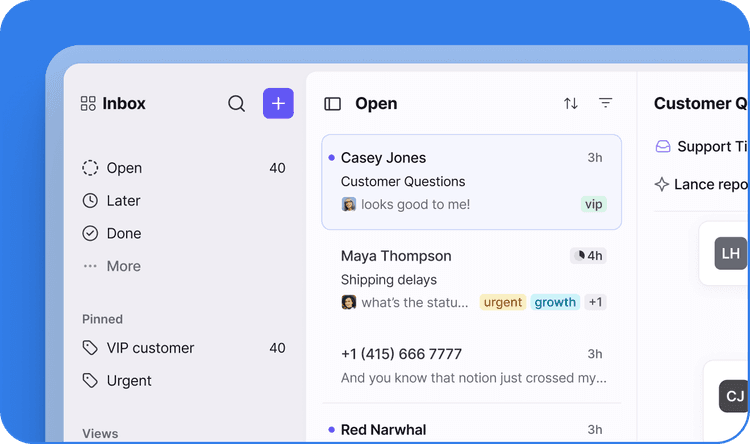
Front’s customer portal lets customers log in to submit requests and track their status for routine, self-service tasks — and because it’s built into the same help center and inbox your team already uses, those requests stay visible alongside everything else your team is working on.
It’s built for B2B teams that want self-service to complement agent support — not operate as a separate channel.
2. Zendesk
Growing volumes make self-service essential for handling routine queries that customers prefer to solve independently.
Zendesk is designed for organizations that rely on a knowledge base and AI assistance to manage those predictable, high-frequency interactions. It centers on deflection and a familiar agent-led workflow. It’s a strong choice for teams looking to reduce repetitive tickets without changing how their operation functions behind the scenes.
3. Salesforce Service Cloud
For companies already managing customer relationships in Salesforce, keeping self-service tied to customer relationship management (CRM) data helps reduce context switching for both customers and internal teams.
Salesforce Service Cloud combines customer portals and knowledge management within the broader Salesforce ecosystem. It’s a good fit for enterprise organizations where customer service is tightly integrated with sales and other CRM workflows.
4. Zoho Desk
Not every team needs an enterprise-scale platform to deliver effective self-service. Zoho Desk provides a focused set of capabilities — a customer portal, knowledge base, and AI features that help customers find answers and monitor progress.
It works well for growing businesses that want straightforward self-service functionality while staying within the Zoho ecosystem.
5. Freshdesk
Rolling out self-service doesn’t have to involve a long implementation or a major operational lift. Freshdesk pairs a customer portal with AI-assisted guidance to help customers resolve common questions before escalating to an expert.
It’s a good fit for B2B teams that want to improve efficiency with self-service that’s relatively easy to launch and maintain, especially when their workflows don’t require extensive cross-team coordination.
Connect self-service and conversations with Front
Choosing a self-service portal is step one. The real payoff shows up in what happens after a customer clicks “submit.” Can they resolve the issue themselves? If they can’t, does the request stay connected to everything your team already knows?
Front brings self-service into your customer operations platform. Customers can search the help center, browse the knowledge base, submit requests, and monitor ticket status while every conversation and follow-up remains connected in one place.
That experience relies on high-quality content: articles written in customer-friendly language, with clear steps, relevant links, and regular updates. It’s also the foundation of effective AI assistance, which only works when the knowledge behind it is accurate and current.
Front’s guide to creating AI-friendly articles offers practical advice for improving self-service content. Request a personalized demo to see how Front unifies self-service and customer conversations for a connected support experience.
FAQ
How do you measure the success of a self-service portal?
Successful customer self-service portals help customers resolve issues without creating more work for your team. Track metrics like self-service resolution rate, reductions in support tickets for common questions, searches with no results, and article feedback to identify content gaps. Monitor whether customers still contact support after using the portal, as that often signals friction or missing information.
What are the best practices for a customer self-service portal?
Self-service portals should make guidance easy to find and simple to follow. Organize content around the language customers actually use, review it regularly, and use feedback to identify and close gaps. When self-service isn’t enough, provide a clear path to human support without forcing customers to start over.
What are some common challenges with customer self-service portals?
Teams often struggle with content that’s hard to find or missing key details, as well as gathering customer feedback that helps improve resources over time. They also run into issues with portals that focus so heavily on ticket deflection that customers end up repeating themselves because context isn’t passed along.
Can a self-service portal improve customer experience?
Yes, a self-service portal can improve customer experience when it reflects how customers look for answers and get support. Accurate answers and the ability to track requests create a more effortless journey. The best portals connect self-service and assisted support so customers can continue conversations without repeating information.