



Learn how AI customer service agents work, where they add value, and how B2B teams coordinate agents and people without losing context or quality.
AI-powered tools are now standard issue in B2B customer service, quietly working behind the scenes. Front’s 2026 Coordination Tax report found that 93% of B2B companies surveyed use AI in customer operations.
The tools are far from perfect, though. Seventy-one percent of those companies faced at least one significant AI issue in the past three months. As AI agents take on more customer work, the challenge is deciding what they should own, giving them the right context, and making sure work can move smoothly between agents and people when needed.
Here’s how AI customer service agents work, so you can pick up speed without lowering the quality of your customer interactions.
What is an AI agent in customer service operations?
An AI customer service agent is a software system that uses artificial intelligence to understand a customer’s request and either resolve issues directly or route them to the correct team.
Whereas a basic AI chatbot follows scripted paths to answer simple questions, AI agents draw on context, your knowledge base, and workflow logic to act on a far broader range of issues — often ones that take several steps.
How AI agents move a request from message to action
A typical agentic AI workflow in B2B customer service runs like this:
A customer sends a request.
The AI agent uses machine learning (ML) and natural language processing (NLP) to identify the customer’s intent and extract key details.
The agent searches sources like the company knowledge base and past customer conversations to gather context.
The AI agent uses that context to generate a response or take an action that complies with company policies, workflow logic, and any other guardrails you create during setup.
The agent either resolves the issue or escalates it to the appropriate team.
Where AI agents create capacity without losing context
Point AI agents to the right work — the tasks that don’t require human intervention — and they earn their keep. These are the main benefits of AI in customer service.
Faster responses
When an AI agent has all the context it needs, it can resolve issues on the spot and give customers quick service. That context includes previous conversations, order history, account health, and other operational data.
More operational capacity
With AI agents handling repetitive requests and automating common workflows, your team can take on more issues while staying in control of the complex ones and the relationships that matter. During setup, you specify what the agent handles itself and how it should recognize compliance issues, contract negotiations, and other scenarios to route straight to a person.
More consistent experiences across connected support channels
AI agents treat every request the same way, no matter the channel. That makes it easier to provide efficient omnichannel customer support, with consistent responses whether a customer uses email, live chat, your customer portal, or another channel.
Better scalability with clear routing and escalation rules
One of the main challenges for scaling support teams is the operational difficulty of routing and managing higher ticket volumes. AI agents allow you to automate these workflows and handle more customers and conversations.
Customer service workflows where AI agents work best
Here are some practical use cases for customer service AI tools, with a clear line between what the agent can safely handle and what should trigger a handoff to a person.
Answering repeat questions like password resets and order status updates
A B2B manufacturing company fields dozens of order status requests a day. The support team burns time sorting them by priority and coordinating responses across channels.
So the company gives its AI agent real-time access to each facility’s order management system. Now the agent delivers fast, accurate status updates on its own, and the support team gets that time back for the complex issues.
Routing shipment delays, billing questions, or account issues
A support team is so buried in requests across channels that no one has time to proactively flag shipment delays.
The company puts an AI agent to work analyzing incoming messages and routing them to the right team. It also has the agent track shipments and send automatic notifications the moment it spots a delay. Customers get more proactive service, and the team can dedicate its attention to the questions that need human judgment and cross-team coordination.
Keeping self-service requests moving until human help is needed
A professional services company provides answers to common queries in its knowledge base, but customers don’t often use it, preferring to email support directly.
The company adds an AI agent to the knowledge base. The tool gives clear answers and handles follow-up questions in a conversational chat widget on the site. It’s also set up to recognize when an issue is too complex or sensitive for an automated answer and to escalate those requests to the support team.
Helping teams step into complex troubleshooting with the right context
A financial services firm runs a chatbot that only answers basic questions, so when customers can’t find what they need, they have to repeat themselves once they reach support.
After the firm upgrades to a more capable AI agent, live chat starts pulling its weight. The agent answers more questions outright — and when it escalates compliance issues and other sensitive requests, it hands the support team the full context instead of making the customer start over.
What AI agents need to handle customer work effectively
Front’s Coordination Tax report found that the common AI issues are extra coordination work, lost context during handoffs, and incorrect request routing. In other words, you’re not just evaluating the AI tool — you’re evaluating the operation around it. To avoid each pitfall, follow these best practices for AI in customer service.
Omnichannel support with shared customer context
Make sure your AI agent can integrate with every operational system your team uses, so it works from the full customer context. That’s what prevents fragmented conversations, produces accurate responses, and spares customers from re-explaining themselves as work moves between AI and your team.
Workflow automation and human escalation controls
Set guardrails that define what the agent handles on its own and when it escalates to a person. That cuts the risk of the AI getting a high-stakes issue wrong, while your team still banks the time saved for low-stakes work.
Knowledge base and operational system integrations
Without real-time access to your knowledge base software and ticketing system, an AI agent will hand customers outdated or wrong answers. Connect it to your knowledge base and other systems, and you can trust the information it gives.
Visibility across teams, handoffs, and workflows
You need a real-time view of how requests move between the AI and your team. Without it, ownership blurs and requests stall. With it, you can catch a workflow bottleneck or a broken escalation and fix it fast.
Coordinate customer service teams and AI agents with Front
AI tools move fast on routine customer work, but they don’t erase the risk of a misroute or unclear ownership. A standalone chatbot can answer basic questions; An AI agent connected to your conversations, knowledge, workflows, and escalation paths holds real value.
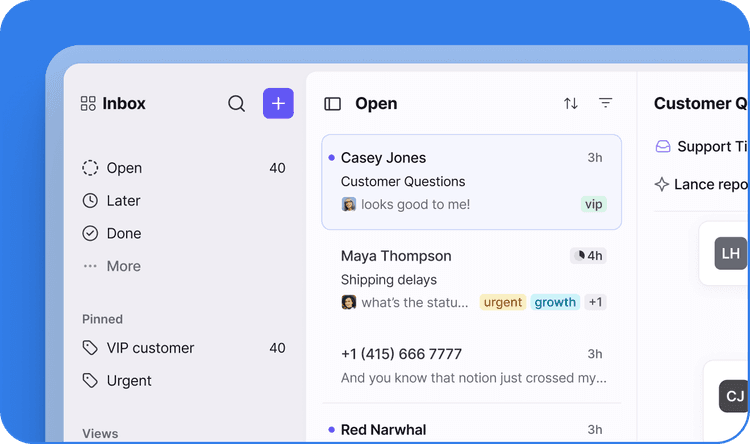
Front is an open customer operations platform where customer service teams can work alongside custom Autopilot agents and external agents with shared context, clear ownership, and coordinated handoffs. Teams can decide which work agents own, keep visibility into how they perform, and bring people in when judgment is needed.
Book a demo to see how Front helps customer service teams coordinate people and AI agents across the work they manage together.FAQ
When should B2B teams avoid automating a customer request with AI?
Keep a person on anything that calls for human judgment or empathy, like contractual decisions, customer complaints, financial approvals, and compliance issues.
Who should own AI customer service agent governance in a B2B team?
Customer service leadership should hold primary ownership, working with IT and other teams on the technical side.
What should teams prepare before launching an AI customer service agent?
Document your customer service workflows, including routing and escalation paths; identify the systems the AI agent needs to access; decide how you’ll measure success; and test the agent on real customer scenarios before a wider rollout.