



8 customer service tips for B2B teams to reduce delays, preserve context, and resolve issues faster across complex support workflows.
Most customer service tips focus on the interaction: respond fast, listen well, show empathy. Those service skills are useful, sure, but they’re the absolute basics. And they fall apart quickly when the underlying operations can’t deliver what’s being promised.
In B2B support environments, multiple teams often touch an account before an issue is resolved. That’s why interaction-level excellence only goes so far — when coordination is weak, even the best frontline skills fall short.
What separates teams that scale well from those that stall is the infrastructure: how information moves, who owns which step, and whether coordination is built into the system.
Before exploring specific customer service tips, start with a simple question: What is excellent customer service in a B2B context? It’s delivering accurate, consistent resolutions without making customers repeat themselves.
The tips below cover both aspects — how to handle customer interactions and how to build the foundation for customer satisfaction at scale.
Customer service tips for teams managing complex support across channels
Support breaks down when there are gaps between channels, teams, and interactions in B2B environments. The following customer service best practices are designed to close those gaps before the customer churns.
1. Capture key context in every interaction
Cisco found that 1 out of 3 support agents lacks the customer context necessary to deliver better customer service.
When agents document interactions poorly — or skip documentation entirely to get to the next conversation — the next person who touches the account has to start from scratch. The customer ends up repeating details, frustration increases, and the team loses time piecing together what happened.
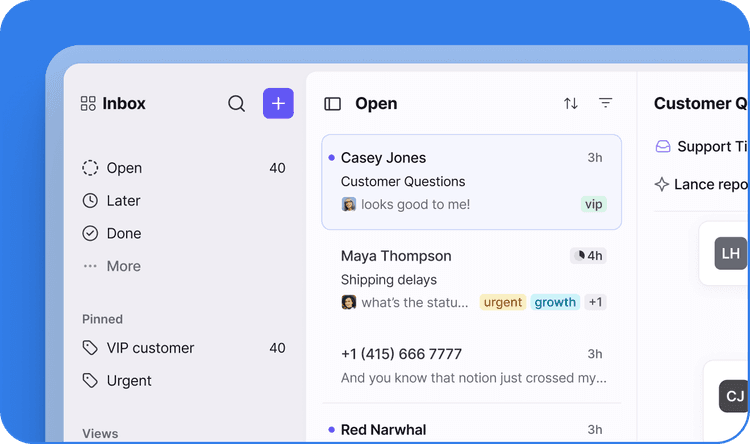
Require your team to record every interaction in a single, shared dashboard: what the issue is, who owns it, and what the next step is. That way, anyone picking up the problem — even 24 hours later — can jump in without asking the customer to start over.
2. Set response expectations that reflect operational reality
According to Zendesk, 70% of customers expect the people they speak with to have full context of their situation. When they connect with someone who has no idea what’s going on, they notice — and it comes across as uncoordinated.
To avoid this, SLAs must account for how work moves across teams, including realistic resolution timelines by issue type. When you build resolution expectations into response times, the focus shifts from replying quickly to fixing problems efficiently.
Those issue types shift as automation takes hold. At Front, the easy tickets have largely gone:
“"Before, we were seeing more of the easier conversations, like ’I need to reset my password,’ ’can you help me change my email.’ The AI agent is taking over those now, which takes the load off our plate. What’s left is deeper, things that need closer attention, like smart rules, dynamic variables, topics that are more workflow-heavy."”
3. Treat product knowledge as routing judgment, not just answer retrieval
One of the most overlooked customer service techniques is knowing not just the answer to a query, but the context needed to own the issue. Is this a configuration problem that belongs with technical support? Is it an expectations gap that finance should handle?
Incorrect routing adds another handoff, often dropping context along the way.
Agents must train for routing judgment the same way they train for product knowledge. Give teams a clear map of which teams own which problem types and make it accessible to everyone.
4. Personalize interactions using full account context
In B2B support environments, personalization is about context more than tone. When a team member picks up a conversation, they should already know the account flagged a billing issue two weeks prior, or that the primary contact changed a few months back. Awareness makes the customer feel seen. Without it, they feel unimportant, like they’re starting from scratch each time.
5. Standardize cross-team communication and handoffs
Klarna offers an example of how support operations are changing — its AI assistant handled the workload of 700-800 employees, cutting resolution time from 11 minutes to under 2. Speed is no longer the bottleneck for teams using AI. Yet continuity is. With AI now handling hundreds of tasks, more interactions are moving between AI and human team members, making it critical to preserve full context across those handoffs.
The lesson applies whether you use AI or not. As work moves between people, teams, or systems, you need clear standards for what information travels with each handoff. Owner, current status, and follow-up steps should all be documented before the handoff, not during or after.
6. Surface account signals early so teams can act proactively
If no one can see the signal, nothing happens. When account activity is spread across disconnected systems — CRM here, support tickets there, and usage data somewhere else — no single agent has the complete picture.
Build visibility within the organization by consolidating account signals into a singular, shared view that every team can access and act on. With the right information in front of them, teams can reach out before the customer has to.
For example, if usage drops sharply for a key feature, an agent can proactively check in to ask whether something broke or if the workflow changed. That well-timed check-in from an informed team member often increases retention.
7. Use automation to route work to the right team
Improving customer service with automation is often framed as a volume metric — AI handles more inquiries in less time, with fewer humans involved. But there’s a bigger benefit under the surface: reduced misrouting.
Create visibility across the organization by consolidating account signals into one shared view that every team can access and act on. With the right information in front of them, teams can reach out before the customer has to.
With the right platform, you can use routing logic that tags and tracks handoffs, then learns from the results to improve routing over time. It’s a feedback loop that ensures more work reaches the right team on the first try.
Founder Shield is saving 300 hours a month by using Front’s automated workflows and native integrations to route messages to the correct shared inbox and auto-assign to the correct owner.
8. Make coordination visible with shared metrics and conversations
Most support teams focus on CSAT and resolution rate. Both matter, but neither alerts support agents to where and when coordination is breaking down before the metrics take a hit.
Teams must track early warning signs, like handoffs per issue and the time spent between teams. Along the way, every team that touches the account should have access to the full conversation history, not just the individual currently assigned to the conversation.
And if the customer calls back, the team fielding the call should be able to immediately see what happened previously, who was involved, and what solutions were promised.
Improve your customer service with Front
In B2B environments — where accounts are larger, and relationships span years — the stakes are higher. A single coordination failure or one escalation lost between teams can cost you a client, undoing months of work in an instant.
The practices in this guide all require a system where context moves cleanly, ownership is visible, and work reaches the right team at the right time. Getting there takes real effort and a solid foundation.
Front is the customer operations platform built for B2B complexity. It keeps every team, tool, and customer conversation in sync. Think of it less as a ticketing system and more as the place your team coordinates work.
Omnichannel keeps context intact as conversations shift between email, chat, or SMS. Workflow automation routes work to the appropriate teams, and collaboration tools ensure handoffs are clean and accountability is clear.
When customer loyalty depends on solving issues where multiple teams are involved, the system underneath determines the outcome. Front is where that workflow runs smoothly.