



Compare the best Hiver alternatives for B2B teams. Evaluate collaboration, automation, and customer operations capabilities to find the right fit.
Hiver turns Gmail into a lightweight help desk, so a shared inbox lives right where your team already works. When most of your customer conversations happen over email, that’s often all you need.
The trouble starts as you grow. Conversations spread across channels and teams; workflows start to require real collaboration and clear ownership; and an inbox — however well-organized — can’t carry that coordination on its own.
In B2B customer service, what determines success isn’t how tidy your inbox is; it’s how well you manage ownership and workflows as work moves across people and channels. That’s the point at which teams start looking beyond Hiver for better visibility, automation, and cross-team collaboration.
This guide compares five Hiver alternatives, outlining each platform’s strengths, limitations, and ideal use cases so you can find the right fit for your team.
Why teams look for Hiver alternatives
Hiver works well for teams that want a shared inbox inside Gmail. But customer communication has to evolve as the business grows, and that’s where Hiver’s Gmail-bound design starts to pinch. Here’s what pushes teams to look for alternatives to Hiver:
Cross-functional collaboration: Hiver limits collaboration to shared notes and email assignments within Gmail. Anything beyond that requires upgrading to Hiver Omni or third-party integrations, which add cost and fragment workflows for teams that want a single collaboration hub.
Multi-channel communication: Hiver is an email-first tool. Chat, Slack, and voice require paying for Hiver Omni, and even then, it treats each channel as its own message stream rather than a single connected customer timeline.
Workflow automation: As a lightweight help desk built on top of Gmail, Hiver handles basic task automation, such as assigning tickets. What it isn’t built for is full workflow orchestration — the kind with shared context and connected systems behind it.
Reporting and visibility: Reporting remains confined to email threads, basic chat analytics, and tags. It can’t pull in non-email workflows or give leaders a single operational view.
Scaling: Because it’s bound to Gmail’s infrastructure, Hiver becomes harder to manage once operations move beyond simple email queues into multi-tier workflows.
Operational complexity: That same Gmail dependency limits high-volume ticket handling and unified customer portals — table stakes for large enterprises and high-touch B2B teams.
What to look for in a Hiver alternative
The right alternative isn’t the one with the longest feature list; it’s the one that helps your team manage growing customer operations with less manual work and better visibility. Four capabilities matter most.
1. Shared inbox collaboration that isn’t chained to Gmail
Shared inboxes are a fine starting line for a small team. But as operations expand, you need a platform that keeps conversations, ownership, and customer context connected across channels, no matter where the request lands — not another one anchored to Gmail.
2. Workflow automation that goes past routing
As volume climbs, manual coordination breaks down. A strong Hiver alternative automates the repetitive work — routing conversations, escalating priority issues — and then goes further, carrying issues toward resolution without constant oversight.
3. Multi-channel communication that stays one conversation
Customers don’t think in channels. They jump between email, chat, social media, and web forms based on what’s convenient, and they expect the thread to follow them. For them, it’s one experience, not separate exchanges.
Pulling those interactions into one workspace gives your team full context and reduces duplicate work, so any teammate can step in without missing a beat.
4. Reporting that shows the operation, not just the inbox
As you scale, leaders need to see more than inbox activity.
Look for reporting on workload distribution, service-level agreement performance, resolution trends, and response times. That’s what makes bottlenecks obvious and keeps service quality steady at scale.
What are the best Hiver alternatives for B2B teams?
No platform is right for every team. Here are five worth a close look.
1. Front
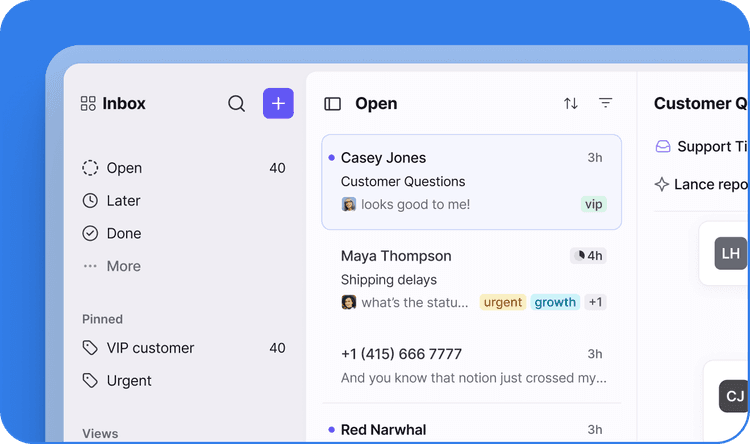
Front is built for teams that have outgrown inbox-centric workflows. It combines shared visibility across customer conversations with clear ownership and internal collaboration, so every team — from support to sales — works from the same customer context.
Workflow automation reduces manual coordination, while AI assistance improves team productivity without taking humans out of the loop. Front ties conversations and systems together, helping teams stay in sync as operations scale.
Best fit: Growing B2B teams that need to coordinate customer communication across multiple channels and functions
Potential limitation: If your team only manages straight email workflows, Front may be more advanced than you need.
2. Freshdesk
Freshdesk offers a well-rounded platform with ticketing, automation, self-service, and omnichannel features. It’s a strong option for teams that want a structured support platform with room to scale.
Best fit: Teams looking for a traditional help desk with room to grow
Potential limitation: Organizations with cross-functional customer workflows may need additional tools to keep non-support teams aligned on customer conversations.
3. Help Scout
Help Scout focuses on making customer support feel personal while keeping collaboration lightweight and intuitive. It’s a good fit for teams that value ease of use over deep customization and operational complexity.
Best fit: Small to midsize teams that want a simple, customer-friendly tool
Potential limitation: As workflows become more advanced or multiple departments need to coordinate, Help Scout’s simplicity may become limiting.
4. Zendesk
Zendesk is a powerful legacy platform with extensive customization, automation, and reporting capabilities. As a ticket-first platform, Zendesk is well-suited for teams managing high ticket volumes and multiple support teams.
Best fit: Larger organizations with mature operations that are already familiar with the Zendesk ecosystem
Potential limitation: Zendesk’s flexibility comes with added overhead, making implementation and ongoing optimization a heavier lift than what fast-growing teams often have capacity for.
5. Fin
Fin builds on Intercom’s conversational support platform with AI that can resolve a variety of customer inquiries and hand off more complex issues to human agents. It’s a strong choice for businesses investing in AI assistance without losing the option of personalized conversations.
Best fit: Teams that want to scale customer support with AI alongside messaging-first experiences
Potential limitation: Teams with operations centered primarily on email or those seeking a more traditional shared inbox experience may find its messaging-first approach excessive.
How to choose the right Hiver alternative for your team
The right call depends on how your team works today and where your customer operations are heading. Don’t stop at feature lists — weigh your workflow complexity and cross-functional needs. A few questions to work through:
Are Gmail-bound workflows holding you back?
How many teams touch customer conversations?
How complex or high-touch are your customer relationships?
What level of operational visibility do leaders need?
Can your current processes support future scale?
Front: the Hiver alternative that keeps every team and conversation in sync
As operations expand, keeping the right people and customer context connected becomes a challenge. That’s where Front comes in.
It’s built for teams that need more than shared inboxes and auto-tagging. It brings customer conversations and cross-functional collaboration together in one place, so teams can easily coordinate across departments and act on the same information.
With intelligent automation and AI that enhances (rather than replaces) human decision-making, Front helps teams act consistently and confidently as customer operations scale.
Exploring platforms for more complex workflows? See how Front improves visibility and coordination. For a deeper look at how those factors impact service performance, download our Coordination Tax report.
FAQ
How can teams evaluate the long-term scalability of a customer communication platform?
Look past today’s requirements and think about how your customer operations will evolve over the next few years. The right platform absorbs more complex workflows, larger teams, cross-functional collaboration, and new communication channels without forcing you to rethink how you work.
How can teams avoid losing customer context when switching platforms?
A well-planned migration preserves conversation history and customer data wherever possible. Choose a platform that centralizes customer context across channels so teams can pick up conversations without losing details during transitions.
How do Hiver alternatives support teams with complex approval or escalation workflows?
Hiver alternatives go beyond shared inbox management by routing conversations to the right stakeholders and triggering escalations based on predefined rules. As you compare options, consider more than Hiver’s pricing and evaluate whether a platform can support the operational processes your team will need as your business grows.