


Compare the top Tidio alternatives and competitors for B2B support teams that need live chat built for real collaboration at scale.
Tidio is a customer service platform that works well for small teams that need quick, lightweight chat automation.
But as companies scale, their support needs become more complicated. More channels, more team members, and more handoffs between departments touching the same customer. That’s when teams start looking for alternatives built specifically for B2B operations.
This guide walks through the top Tidio competitors to consider in 2026, with a side-by-side comparison tto help you find the right fit for your team.
Tidio alternatives in 2026: A side-by-side comparison
Here’s a quick look of Tidio’s main competitors and their operational attributes.
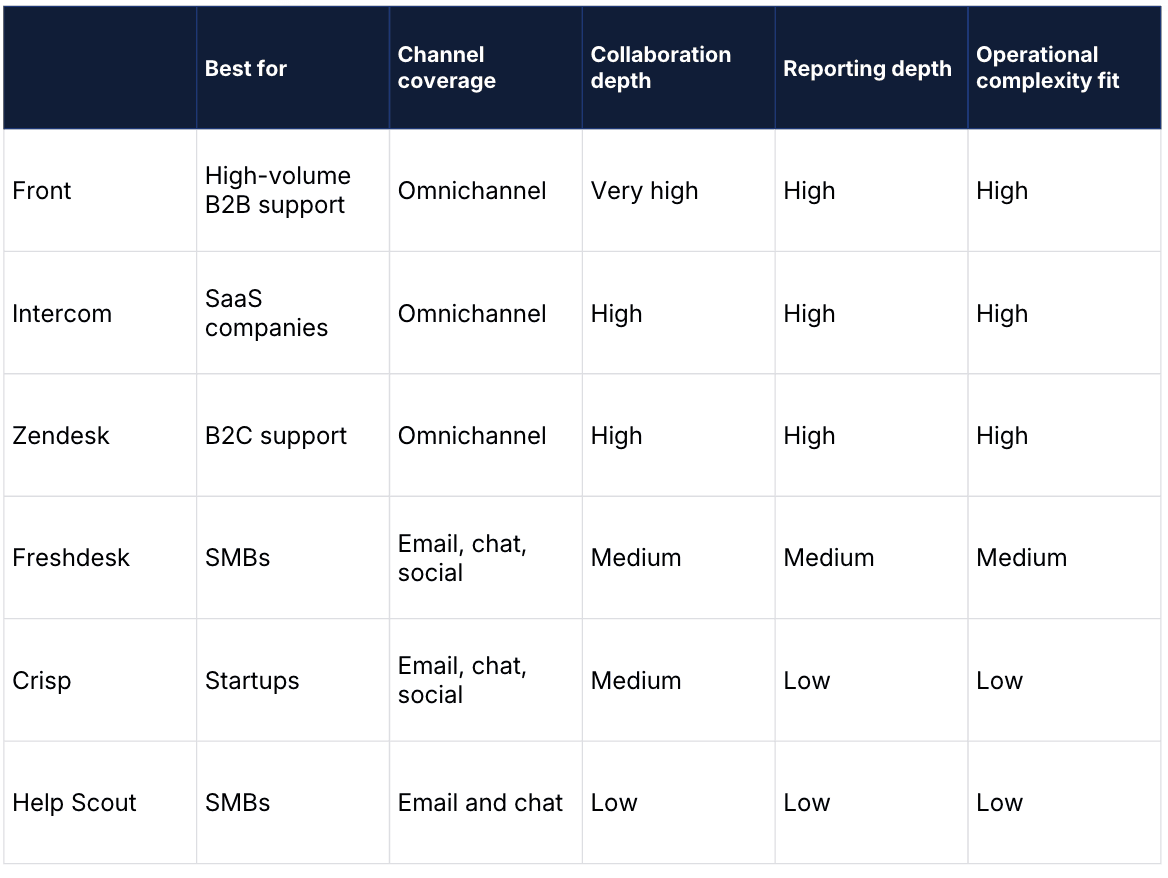
You can learn more about each tool in the full breakdowns below.
Why look for a Tidio alternative?
Tidio is easy to set up and offers solid features for live chat and routine automation through its Lyro AI agent. It’s ideal for B2C teams handling large volumes of repetitive customer queries. But as operational complexity increases, Tidio’s simplicity becomes a constraint.
Workflow limitations
Tidio’s workflows are designed for basic chatbot conversations, making it difficult to manage B2B inquiries that often involve multiple teams and systems. Over time, handoffs can get messy, ownership blurs, and teams start to find manual workarounds using other apps.
Live chat focus
Tidio excels at live chat. But B2B teams need more than a set of standalone tools — they need a unified workspace that keeps long-running, multichannel conversations together with a single, shared history.
Simple automation
Automation features in Tidio work well for predictable customer interactions, but B2B teams scaling up need more advanced workflow automation: multi-step routing, conditional assignment, and escalation paths. Plus, they need robust reporting that goes beyond Tidio’s chat metrics and includes SLA tracking and workload visibility.
B2B teams look for alternatives to the Tidio chatbot because it’s designed for B2C speed and volume, not for the coordination and complexity that come with B2B growth.
Key criteria for choosing a Tidio alternative
When you’re evaluating alternatives to Tidio AI, the right choice is the one that best meets your team’s actualneeds, not necessarily the one with the longest feature list. Here are the main criteria to consider.
Omnichannel conversation unification
In B2B operations, customers send messages on multiple channels, from Slack and Teams to email and live chat. When those conversations live in different tools, context falls through the cracks and customers end up repeating themselves. Look for a tool that brings multichannel conversations together into a single, omnichannel support platform.
Internal collaboration and ownership clarity
Our latest research shows the typical B2B company spends nearly three hours coordinating for every hour spent solving customer problems. When ownership is unclear, handoffs become complicated and work gets duplicated or missed. You need customer service software with features like tagging and internal notes that make cross-team collaboration run more smoothly.
Automation beyond chatbot scripts
Simple, script-based FAQ bots handle repetitive questions, but when issues require deeper context or coordination, they stumble and leave customers frustrated. You need a full-featured AI chatbot platform that automates the work behind the conversation — routing, assigning, and escalating based on urgency, conversation type, or account tier.
Reporting that reflects operational health
Simple metrics like chat volume and response time are OK for small teams, but as the business grows, you need more sophisticated analytics to manage your team and maintain operational efficiency. Choose a tool that tracks the B2B metrics that matter — like SLA performance, agent workload, and escalation trends.
The 6 best Tidio competitors of 2026
Here’s a detailed breakdown of the best alternatives to Tidio chatbot, selected based on what they offer B2B teams at different operational stages.
Front
Front combines live chat, chatbot flows, and AI automation. Autopilot handles defined workflows, while Copilot assists agents without replacing human judgment.
What differentiates Front is the coordination layer: every channel, team member, and conversation stays in sync. The multichannel workspace preserves context across long-running interactions and maintains clear ownership, and automated routing enables scalability.
Front is best for B2B teams managing high-volume, multichannel support where multiple departments touch the same account. Because it’s built for complex customer environments, B2C companies focused primarily on deflecting tickets may not use its full suite of features.
Intercom
Intercom offers a fully featured help desk with an integrated AI agent called Fin. It’s designed for teams that want to combine different channels into a unified platform and lean on automation. Its AI-first approach gives customers useful self-service options and helps teams handle routine workflows.
Intercom is best for SaaS companies. Teams looking for a simple chatbot may find it too complex and expensive, and would be better off with alternatives to Intercom.
Zendesk
Zendesk started as a simple online help desk but now offers full omnichannel support. Its live chat features are part of a broader suite that includes ticketing, workflow automation, and strong reporting. Enterprise teams lean on its scalability and customization options.
Zendesk is a strong fit for B2C companies with large support teams, but comes with a complex setup and maintenance requirements. For B2B companies, it doesn’t offer the cross-team coordination layer that alternatives like Front provide.
Freshdesk
With its Freddy AI and Freshchat features, Freshdesk offers sophisticated live chat as part of its multichannel customer support platform. It comes with a self-service knowledge base, strong analytics, and suggested responses to help your team save time on responses.
Freshdesk strikes a reasonable balance between capability and usability: powerful features without too much complexity, making it easy to set up and maintain.
This makes Freshdesk a good choice for small and mid-sized teams focused on ticket deflection and self-service. Complex B2B organizations may outgrow its workflow depth quickly.
Crisp
Crisp is a direct Tidio competitor with its focus on chat-based workflows. Its workspace mimics popular messaging platforms, making it great for customer engagement. It also stands out for its clean interface and third-party integrations, which extend its functionality beyond basic chat.
Startups and small teams will appreciate Crisp’s focused approach, but larger teams may find its reporting and automation features limited.
Help Scout
Help Scout is built around a shared inbox and comes with Beacon, an AI-powered live chat tool. It offers automated workflows, tagging, and routing in a clean interface. What differentiates Help Scout is its simplicity: It’s easy to use for both customers and employees.
Help Scout is a good choice for teams that value personalization and ease of adoption. Companies that need deeper automation, analytics, or omnichannel support may find themselves looking for alternatives to Help Scout.
How to choose the right Tidio alternatives for your business
The right AI customer service software for your team depends on where your operations are today.
If you run a small team that just needs website chat and basic chatbot automation, your priorities will be ease of deployment, chatbot capability, and basic reporting.
But as operations grow, priorities shift. A larger team with more channels, teammates, and handoffs will need multichannel coverage, cross-team coordination, and complex workflow automation features. In multi-stakeholder B2B environments, end-to-end visibility and scalable routing logic become the deciding factors.
Handling complex customer conversations with Front
Most live chat tools are designed to handle high-volume B2C queries, but they don’t offer the cross-team collaboration features that B2B support teams need.
When conversations sit in different tools, ownership gets unclear and routing breaks down — and the customer feels every minute of it.
What makes live chat work at scale is the coordination layer around it. When every channel lives in one workspace, ownership is explicit, and routing adapts automatically, teams move faster and customers notice.
Front is built for B2B customer support teams, with live chat as one channel within a broader omnichannel workspace. After adopting Front Chat, Mixam’s first-response times improved by 60%. Plus, its email and call volume dropped by 16% as more customers shifted to the faster chat experience.
Book a demo to see how Front helps you offer your customers a better, more integrated live chat experience.