



Compare Front alternatives ranging from Help Scout to Zendesk, and see how they differ across collaboration, automation, reporting, and complex B2B workflows.
Operations leaders aren’t looking for more software. They want to know whether the handoff happened cleanly, if teams share the same customer story, and where something critical is quietly slipping.
Visibility, not the volume of software, is the real pressure point. And while several tools claim to solve this problem, most break down as complexity increases.
This guide explores the competitive field: what Front alternatives offer, their strengths and gaps, and how Front holds up when support demands intensify.
When Front is the more suitable fit
Teams don’t always decide to swap software because something broke. Sometimes, the trigger is growth, new processes, or added complexity.
In those moments, the question isn’t “What else is out there?” It’s whether the current setup still supports how the team works and whether a switch would improve outcomes.
The bar for switching is high: any alternative must meet or exceed what’s already in place, or the disruption isn’t worth it. In that context, Front consistently impresses organizations looking to swap.
Here’s why Front remains the best solution for complex B2B operations.
Coordination without extra layers
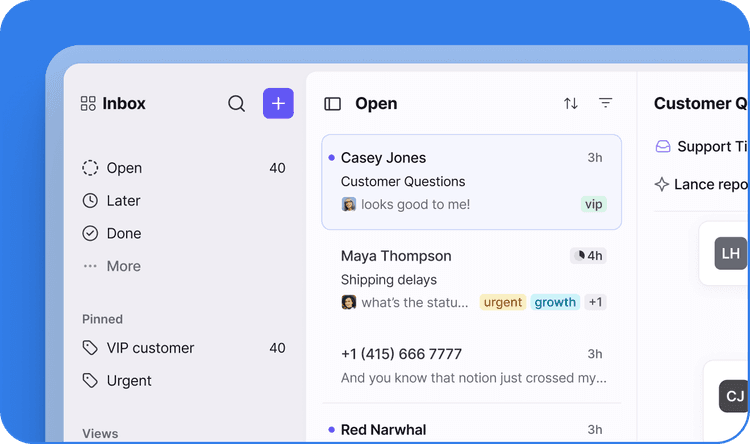
Front is conversation-first, not ticket-first. That distinction matters when an issue touches multiple teams, and legal, account management, and support must all weigh in on the same thread.
In a ticket-based system, coordination spills into Slack or side email threads. Front consolidates it — assignments, @mentions, and internal comments all stay inside the original conversation. There’s one thread with full context and no duplication slowing things down.
Context that carries through
Few things frustrate clients more than having to repeat themselves. It signals disconnected teams and erodes customer confidence. Front prevents this by keeping CRM data, history, and internal notes visible within the conversation. Whoever picks up the thread — regardless of team — can move forward immediately.
Reed & Mackay’s 97% CSAT score illustrates the impact. When agents stay aligned and don’t start from scratch, service quality improves, and customers feel the difference.
Reporting you can act on
Front’s analytics surface the signals that matter most: SLA compliance, response times, workload distribution, and CSAT trends. These aren’t vanity metrics — they show whether work is moving as expected, especially when a single delay can affect revenue or customer retention.
Branch used this visibility to increase productivity by 40% and cut $715K in costs by fixing coordination gaps instead of hiring more staff.
Front pricing as a tradeoff
Front’s pricing intentionally strikes a balance of offering more value at an affordable price compared to other legacy options. It reflects the platform’s focus on multi-channel routing, automation, and deep integrations that B2B teams rely on as operations become more complex.
Key criteria for evaluating customer operations tools
Before you start comparing platforms, define what “better” means for your teams. Use these questions to determine what you need:
Does context follow the conversation as it moves between teams? If customers have to repeat themselves, the gap shows up in time and frustration.
Can your team adjust workflows independently, or does every change rely on IT? Heavy reliance on IT slows responses when volume spikes.
Does reporting reveal outcomes or just volume? Volume is easy to measure, but outcome metrics are what influence customer retention.
How does the system behave as the team scales? Most software works fine with 10 seats. But at 50, coordination gaps surface.
Front vs. competitors: Which platform matches your team’s needs?
There’s no shortage of Front competitors, and many offer strong capabilities. The goal here isn’t to rank them but to help you determine which platform aligns with how your team actually works. As you review options, look beyond the feature list or built-in AI agents, and consider the use case it was designed around.
As you review options, look past the feature list and consider what each tool was built to do.
1. Fin
Fin is designed to support businesses with real-time chat, in-app messaging, and AI that handles repetitive questions, reducing the workload of human agents. For SaaS companies, where primary support focuses on real-time interaction inside the product itself, it’s a strong fit.
In most B2B environments, though — where customer relationships span months, involve multiple stakeholders, and depend on ongoing email threads — Fin falls short. It wasn’t designed for long-running conversations or shared ownership across teams. For real-time messaging, it’s great, but it isn’t built for extended multi-team coordination.
2. Freshdesk
Freshdesk focuses on managing support requests for teams that need defined queues, clear escalation paths, and an accessible workflow. For many companies — especially those just building out customer support infrastructure — the free plan and straightforward setup make it an easy starting point.
The limitations appear quickly, though. As operations grow complex, coordination across teams — connecting a support ticket to account management, involving finance, or maintaining context across multi-step escalations — can strain the system. Freshdesk handles isolated requests well, but cross-functional collaboration is where it tends to struggle.
3. Trengo
Trengo, like Fin, revolves around real-time messaging. It consolidates WhatsApp, Instagram, email, and live chat into a single workspace. It’s effective for teams managing high channel volume, particularly in European mid-market companies where WhatsApp is the primary support channel.
Where it falls short is deeper coordination. Multi-team processes with complex escalation paths require more than channel consolidation. Trengo handles messaging well, but it isn’t built for the kind of operational depth that B2B workflows demand.
4. Missive
Missive syncs email, chat, and task management in a clean, well-designed interface. For small teams focused on shared inboxes, it’s a strong Front alternative.
As those teams grow, reporting and automation become the limiting factors. Missive’s reporting is lighter than most competitors, and teams may find themselves building workarounds for SLA tracking or escalation logic. It’s a good fit for small, collaborative teams that are largely email-centric.
5. Help Scout
Help Scout built a reputation around its clean UX and focus on human support interactions. It’s a popular choice for small teams handling email-based support, delivering a straightforward, reliable experience. It works best when the goal is individual, thoughtful replies rather than high-volume operations.
That simplicity becomes a constraint as teams grow. Bring in multiple departments, multi-channel conversations, or SLA accountability at scale, and the system starts to show its limits.
6. Zendesk
The majority of the Front software alternatives above are focused on small-team support or real-time interactions. Zendesk is different: It’s built for enterprise environments and offers deep customization, extensive integrations, and detailed reporting. Zendesk is powerful, but the power comes with operational overhead.
Setup, maintenance, and iteration require dedicated admin resources, and that investment compounds over time. If your business has the infrastructure to support Zendesk, it’s a strong choice. But if you prefer to own your workflows and need the flexibility to move fast, it may feel restrictive.
See how Front helps teams coordinate multi-channel workflows
When multiple teams, channels, and stakeholders are in play, breakdowns follow similar patterns — messages get lost, ownership blurs between teams, and context disappears at the precise moment it matters most.
When that happens, it’s always a high-value client waiting for a resolution. They lose faith, and you lose business.
Front is designed for that fast-paced environment where results matter, and small setbacks have lasting effects. It keeps conversations, context, and ownership aligned so teams can scale without losing control over key systems or processes. The impact is clear: Mixam has improved response times by 60%, and Uber Freight responds to customer emails 50% faster.
Evaluating Front customer support alternatives because cost is a concern is valid. But the more important question is what a coordination failure will cost you: in missed SLAs, in lost context during handoffs, and in escalations that should have been caught two steps prior.
Does your current system make that better or worse?
Download the Improving the Customer Experience report to better understand why timely, personalized, multi-team responses depend on centralized conversations, clear ownership, and end-to-end visibility across your operations. Then, use those criteria to evaluate the platforms you’re considering.
FAQ
How does Front support onboarding new team members efficiently?
Front’s shared inbox lets new team members step into full conversation history immediately. Assignments and internal comments show what’s done, what’s active, and who owns what, so new hires can focus on the work instead of reconstructing past conversations.
How does Front improve collaboration between customer support and other departments?
Front ties collaboration to the conversation. When support requires input from finance, operations, or legal, it happens in-thread — without breaking context or exposing internal back-and-forth to customers.
Can Front Analytics track all customer service KPIs?
Front natively tracks operational metrics like response time and volume. For business-level metrics (CLV, churn) or survey data (NPS, CES), Front integrates with your CRM and survey tools to connect your support data with your broader business ecosystem.