


Compare Intercom vs. Zendesk vs. Front across AI, collaboration, reporting, and support models to choose the right fit for complex B2B workflows.
Every customer support system has the same goal: resolve the issue quickly and correctly. But the path each one takes to get there is wildly different.
Comparing Intercom, Zendesk, and Front shows how differently they shape the day-to-day rhythm of customer service teams. One leans into conversational workflows, another into structured ticketing at scale, and a third into customer operations that work the way internal teams already talk to each other.
For most B2B teams, the right system comes down to one question: how does work actually move through your organization? This article breaks down the strengths and weak spots of Intercom vs. Zendesk vs. Front to help you figure out which tool is best for your team.
Intercom vs Zendesk vs Front: A quick breakdown
All three cover roughly the same ground: resolving support requests over email, chat, some form of AI, and some form of automation.
Here’s a quick breakdown of those models:
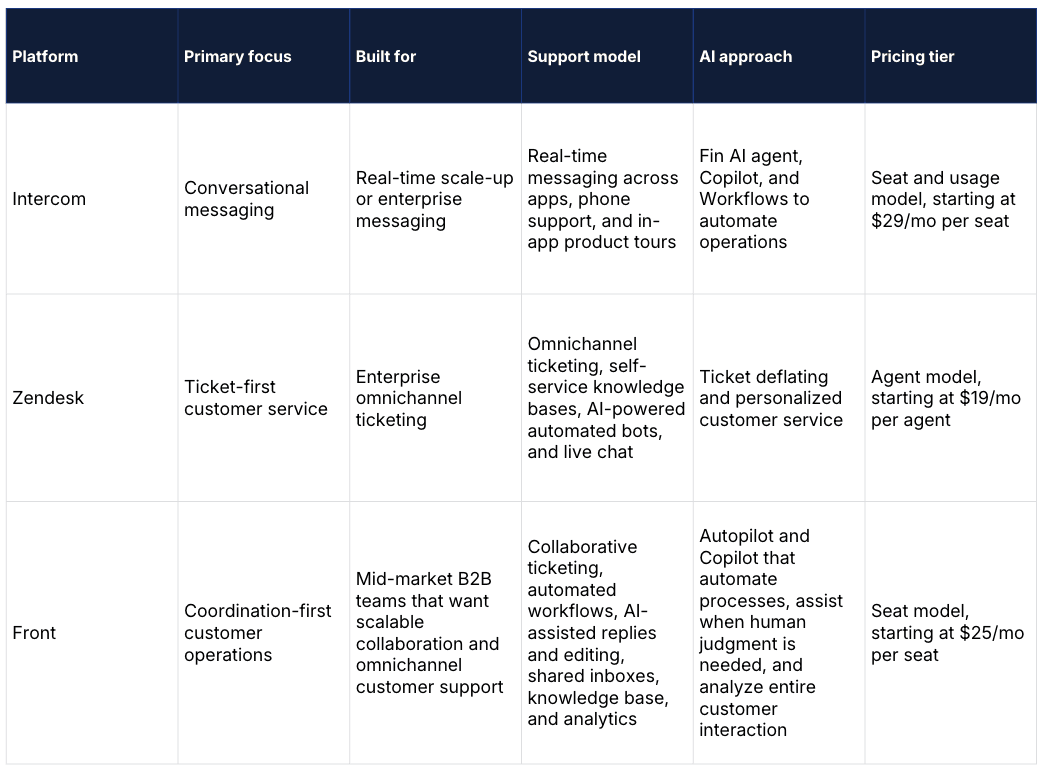
But the differences that matter live in the use cases. Where Zendesk shines might be something your team will never touch.
Keep in mind this table only captures what each platform optimizes for on the surface. For a closer look, read the head-to-head comparison below to see the architectural and operational differences that decide which platform can handle complex B2B work.
What is Front?
Front built to get teams up and running fast, whether you want to keep every conversation in one place or help reps collaborate at scale. It’s built around conversations, not tickets, and absorbs the complexity of B2B operations without taking control away from your team.
Here’s how Front becomes the operational layer that connects how teams actually collaborate around customer work:
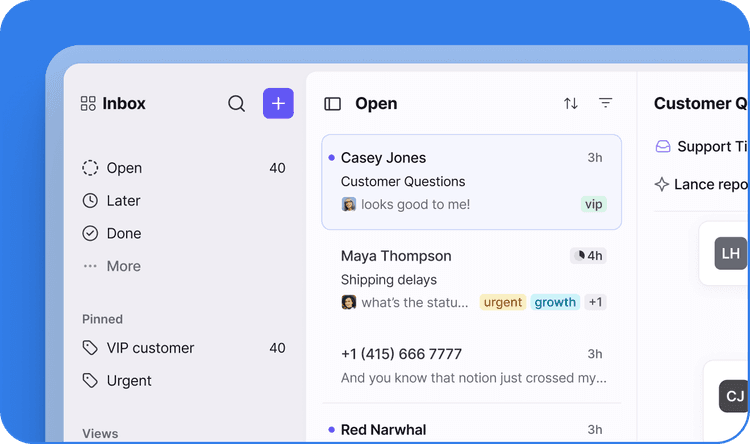
Shared inboxes: Every conversation lives in one place, giving teams a single, transparent view of customer work as it happens.
Assignments: Every thread shows who owns it, so nothing slips and everyone knows who’s up next.
Internal comments: Collaborate in real-time inside the conversation, keeping context intact without switching tools.
Workflow automation: Handle repetitive steps automatically so teams can focus on moving work forward or making decisions that require human judgement.
Front’s conversation-first model holds up best for three jobs: juggling work across multiple teams, keeping everyone in sync, and making sure context survives every handoff.
What is Intercom?
Intercom is a customer messaging platform built around conversational engagement and AI-driven deflection.
It focuses on customer-facing interaction at the point of contact, not internal coordination. The idea is to start, resolve, or deflect conversations quickly inside the product. Coordination behind the scenes takes a back seat—this is mainly an engagement and support layer.
Intercom’s engagement-first model holds up best in three scenarios: in product-led B2B or B2C environments, during onboarding flows, or at organizations with high deflection goals.
What is Zendesk?
Zendesk is an enterprise-grade customer support platform that handles queue management, service-level agreement (SLA) enforcement, omnichannel routing, and deep reporting through Zendesk Explore. It’s built around a ticket-first model, which focuses on creating and processing support tickets, not conversations.
Zendesk’s ticket-first model also enables large teams to handle high volumes in a controlled and consistent way, because the work is easily trackable and measurable.
This model works best for these criteria: when organizations have reporting-heavy operations, high-volume environments, and structured workflows.
Front vs. Zendesk vs. Intercom for customer support: Head-to-head comparison
Rather than reducing Front vs. Zendesk vs. Intercom functionality to a checklist of features, we evaluated them against the realities of complex B2B work: support philosophy, AI and automation, collaboration, and reporting and analytics.
Support philosophy
We consider support philosophy as the core design principle behind each platform.
Each platform treats the core task differently. Zendesk’s basic unit of work is the ticket. A customer writes in, a case is created, a status is assigned, and the system starts marching toward a resolution. If you’ve ever watched a support lead spend the morning sorting by priority tags and SLA breaches, you’ve seen Zendesk doing exactly what it was designed to do: run support at scale.
Intercom starts from a different assumption. Its unit of work is the customer-facing conversation. Support feels more like live messaging than case management —faster replies, multiple threads running at once. A customer can ask about pricing in chat, disappear for two days, then reappear in the same thread to ask about onboarding. The point is continuity.
Front goes one step further, into the conversation that happens around the customer interaction itself. Open a message in Front and you’re as likely to see teammates assigning owners or looping in another department as answering the customer. It’s built for the reality where support and operations constantly overlap.
AI and automation
Zendesk’s AI strategy is built for high-volume help desk environments where speed matters most. Its AI agents are “sidekicks” that can resolve conversations on any channel, while the Zendesk Resolution Learning Loop learns from every interaction to improve automation over time.
For repetitive queries, tagging, routing, and automated suggestions, Zendesk can take work off your plate. In practice, though, many teams keep paying for an expanding stack of AI add-ons without seeing meaningful deflection on more complex support work.
Intercom takes a similar AI-first approach with Fin, its customer-facing AI agent: both platforms aim to automate responses and deflect tickets fast. For routine questions, the efficiency is real.
But since Fin launched in 2023, the tradeoff hasn’t changed: it works best when all your knowledge lives inside Intercom, and auto-replies still occasionally get answers wrong and stumble on complex queries.
Front approaches AI differently, keeping a human in control. Its “Automate, Analyze, Assist” framework is designed to leave judgment to your reps. Autopilot handles high-volume FAQs, while Copilot helps your team draft the most accurate response. Every decision is owned by a person.
Collaboration
The basics of internal collaboration across all three platforms are the same: shared inboxes or side conversations, @mentions for increased visibility, and assignments.
What Zendesk’s chat vs. Intercom’s comes down to is structure:
Zendesk treats collaboration as a support escalation path, rather than an ongoing team conversation. It’s ticket-based and tightly connected to queues and workflows.
Intercom keeps collaboration inside the customer conversation itself as it’s optimized for fast-moving chat and handoffs between sales and support, but it doesn’t support every customer touchpoint, especially those scattered across multiple channels.
Front mirrors how teams actually coordinate under pressure. Conversations become shared workspaces where support, operations, finance, and any other team can comment internally and resolve issues without losing customer context.
Reporting and analytics
Reporting and analytics is where these platforms show what they were really built for.
Intercom’s reporting stays close to the customer conversation: customer satisfaction (CSAT), response times, peak activity windows, resolution rates. If your team lives in live chat and wants a read on customer engagement, the insights feel immediate and useful. But it lacks the company-wide analytics Zendesk offers.
Zendesk goes in the opposite direction. Its reporting is highly customizable and built for enterprise-scale customer support. Ticket trends, agent productivity, CSAT, SLA performance, forecasting—almost everything is measurable. The tradeoff is complexity, and a steep learning curve to match.
Front focuses on operational visibility. Its analytics track workload distribution, collaboration patterns, recurring conversation topics, Smart CSAT, Smart Quality Assurance (QA), and response times in ways teams can act on immediately.
The tradeoff with Front is less enterprise-level reporting depth. But for B2B teams managing high-touch accounts, that usually means faster decisions and less time buried in dashboards.
Why B2B businesses choose Front
For years, Intercom and Zendesk have focused on the customer-facing layer of support where tickets are created, routed, and resolved. But behind that moment sits another layer of work that usually goes unnoticed: the internal coordination and decisions that determine whether an issue actually moves forward.
That’s the layer Front was built for.
Instead of centering the ticket, Front centers the conversation —where context builds. As work moves across teams, that context moves with it instead of getting buried in ticket fields. The result: fewer restarts and less time repeating what’s already been said.
Front turns the inbox into more than a queue. It becomes the operational spine where teams coordinate in real time and carry context through complex workflows.
Ready to see it for yourself? Request a demo today.