



Compare the best tools to manage multiple email accounts, with reviews and practical guidance to choose the right email management app for teams.
When you manage a steady flow of customer conversations across multiple inboxes, you need email management software that can keep up.
Basic email providers and makeshift workarounds quickly collapse as volume and complexity grow, making it hard to track who’s handling what. But with the right email management software, you can manage multiple email accounts easily by bringing all customer communication into one organized, shared inbox. By giving different teams access to the same inbox, you maintain clear accountability and keep every interaction tidy, so nothing falls through the cracks.
Here, we compare eight of the best email management tools to help you pick the best one for your business.
8 tools for managing different email accounts: Reviews and features
In this section, we compare eight different email management apps, from team collaboration platforms to enterprise email clients and individual providers. You’ll get a clear view of their features and pricing so you can decide the best fit for your team.
Team collaboration platforms for multi-person operations
Multi-person operations rely on tools that help teams stay connected and coordinated. These platforms centralize communication and keep everyone on the same page. Here are four leading platforms, plus their pricing, reviews, and key features.
1. Front
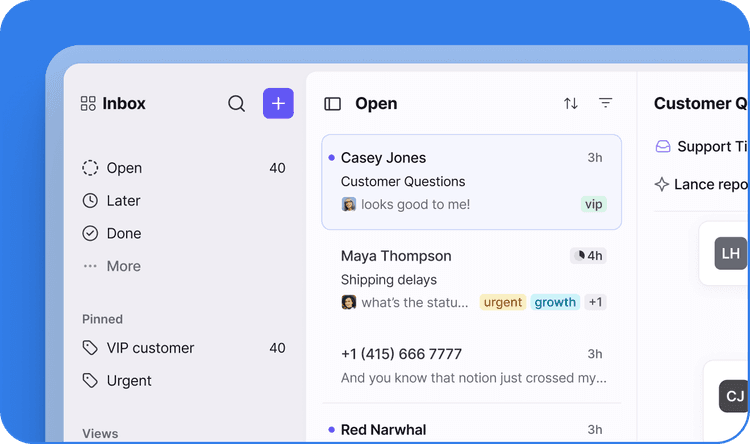
Front gives teams omnichannel support with built-in collaboration and workflow tools. Teams can share inboxes, assign messages to different team members, and organize conversations with tags. AI tools help you personalize responses and manage higher email volumes efficiently.
Here’s an overview of the platform:
Pricing: $25 per user per month for the Starter plan, $105 for Enterprise
Current G2 rating: 4.7 (2,410 reviews)
Key features: Shared inbox, omnichannel support, AI-driven workflow automation, collaboration tools like tagging, internal notes, and collision detection, plus integration with a wide range of tools, such as Slack, Asana, WhatsApp, and Salesforce
2. Missive
Missive provides a unified inbox that brings conversations from multiple channels in one place. It’s known for its quick setup, a clean interface, and straightforward automation and collaboration features.
Here’s an overview of the platform:
Pricing: $14 per user per month for the Starter plan, $36 for Business
Current G2 rating: 4.6 (732 reviews)
Key features: Automation rules, internal chats and threads for collaboration, integrations with Slack and Trello
3. Help Scout
Help Scout combines shared email with help-desk features, making it a solid option for support teams looking for an integrated solution. Its interface is easy to navigate, and it includes collaboration tools like internal notes.
Here’s an overview of the platform:
Pricing: $25 per user per month for Standard, $75 for Pro, Free plan for a single inbox with basic features
Current G2 rating: 4.4 (423 reviews)
Key features: AI summaries, automated routing, collaboration tools, ability to assign emails to specific team members
4. Hiver
Hiver works with different email clients, but is best known for its close integration with Gmail. Users report that it feels native to the Gmail environment, so it’s an easy upgrade for teams already using Google Workspace.
Here’s an overview of the platform:
Pricing: $25 per user per month for Growth plan, $105 for Elite, Free plan with basic features
Current G2 rating: 4.6 (1,274 reviews)
Key features: Shared Gmail inboxes and folders, AI assistant for drafting and summarizing emails, custom analytics, rule-based automation
Enterprise email clients with team features
Enterprise email solutions are built for companywide use but aren’t specifically designed for managing multiple email accounts. They offer limited collaboration features compared to dedicated team-collaboration platforms.
Here’s a look at the top options and what they offer.
5. Outlook
As part of Microsoft 365, Outlook remains a common choice for businesses already using the Microsoft suite. While it supports shared mailboxes, it lacks more advanced collaboration features like internal chat, notes or comments. It’s best for teams that need a cost-effective way to manage emails and tight integration with other Microsoft tools.
Here’s an overview of the platform:
Pricing: $6 per user per month for Microsoft 365 Business Basic, $22 for Premium
Current G2 rating: 4.5 (3,292 reviews)
Key features: Tight integration with other features of Microsoft 365 like calendar, contacts, and tasks, plus potential cost savings if the business already uses the Microsoft suite
6. Spike
Spike is known for its conversational, chat-like email experience. It turns email threads in your inbox into a format similar to messaging apps like Slack or WhatsApp.
Here’s an overview of the platform:
Pricing: $5 per user per month for the Pro plan, $10 for Ultimate
Current G2 rating: 4.6 (257 reviews)
Key features: Chat-style interface, support for voice messages and video calls, AI tools to generate and summarize messages
Individual email clients
Individual email clients let you manage multiple email accounts from one dashboard. They’re built primarily for individuals but can also work for small teams that need basic collaboration features.
Here are some top solutions and what you can expect from these tools.
7. Mailbird
Mailbird is known for its minimalist interface. It provides a simple way to manage multiple email accounts through a single dashboard, without a steep learning curve.
Here’s an overview of the platform:
Pricing: $5.78 per user per month (with discounts for more users), Free for single account with basic features
Current G2 rating: 3.6 (101 reviews)
Key features: Integration with apps like Google Calendar and ChatGPT
8. Gmelius
Gmelius is primarily built for use with Gmail accounts, although an Outlook integration is in the works. It aims to save you time with its AI assistant, automation rules and shared email labels for everyday workflows.
Here’s an overview of the platform:
Pricing: Starts from $19 per user per month
Current G2 rating: 4.4 (776 reviews)
Key features: Automation rules, shared email templates, advanced analytics, AI assistance with drafting and routing emails
How to pick the best email management app when visibility and ownership matter
When you’re managing high-value B2B customers, you can’t afford to miss a single email. Effective email management software helps you manage the complexity of everyday operations, while staying organized and keeping customers happy.
Here are some key criteria to consider when choosing the right tool for your team.
Clear ownership and accountability
Look for email management software that helps you assign emails to particular team members. That way, everyone on the team knows who’s responsible for what and you don’t end up duplicating effort or letting a message slip through the cracks.
Visibility across teams and channels
Every team should be able to see every customer interaction, no matter which channel it comes through. Choose a provider that gives you omnichannel support and makes it easy for different teams to collaborate behind the scenes.
Ability to handle complexity without workarounds
Complexity is a given when you’re supporting multiple customers, each with a large team that could reach you on multiple channels. You need a tool that helps you manage that complexity head-on, not one that forces you to work around it.
Measurable impact on performance
Choose a solution that shows you real results — not one that makes vague promises about time savings. You need solid data showing a measurable improvement in your team’s performance, and a reduced risk of lost emails and other mistakes. Look for high-quality dashboards and analytics that make it easy to track the impact of your email management strategy.
Integration with your existing tools
For business support teams, email shouldn’t be a stand-alone app. You need email to integrate with the other tools you use, from messaging apps like Slack, and workflow tools like Trello, to CRM systems like Salesforce.
5 operational best practices for managing multiple email accounts
Our guide to managing work email covers in detail what works when you’re managing multiple email accounts. But here are five best practices to get you started.
Establish clear assignment protocols: Make sure every message has an owner, so it’s clear who’s responsible for replying and no message goes unaddressed.
Set up cross-team routing rules: Use automatic rules to route messages to the right team based on the content. For example, ensure billing questions go to finance and technical issues to customer support.
Build dashboards for operational oversight: Use analytics and dashboards to give your whole team a real-time view of volume, SLAs, and team workload, so they can adjust priorities as needed.
Set target response times: Tell your team how quickly they need to respond to customer emails, and give them the staff they need to meet that target.
Prioritize based on urgency: Use AI tools to scan message content and flag high-priority requests for quicker responses.
“No need to look for any other tool, Front checks every box”
This quote comes directly from MongoDB, one of the 9,000 businesses using Front to deliver excellent customer service.
As your business scales and the customer interactions become more complex, you need smooth collaboration and clear accountability to stay organized. Choose an email management solution that gives your team clear visibility into all customer interactions within a shared inbox.
Front is the ideal solution to manage the complexity of shared email inboxes. With its omnichannel support and automated workflows, Front helps your team collaborate and respond faster to meet your customers’ expectations.
Book a demo with Front today to see how easily you can manage multiple email accounts.