



Every shipment creates two expectations: the freight arrives on time, and the customer always knows what’s happening. Meeting the first depends on trucks, drivers, and careful planning. Meeting the second (the one that keeps customers coming back) requires hundreds of conversations to stay coordinated across teams, shifts, and time zones.
Gie Reklaitis, Director of Sales at GP Transco, works at the center of that coordination. He leads sales, account management, and the operations-adjacent teams responsible for protecting customer relationships and keeping every commitment intact long after a deal is signed.
“In trucking, great service looks like responsiveness and predictability. Shippers want fast answers, proactive updates before they have to ask, on-time pickup and delivery, and one consistent experience no matter who on our team they reach,” says Gie.
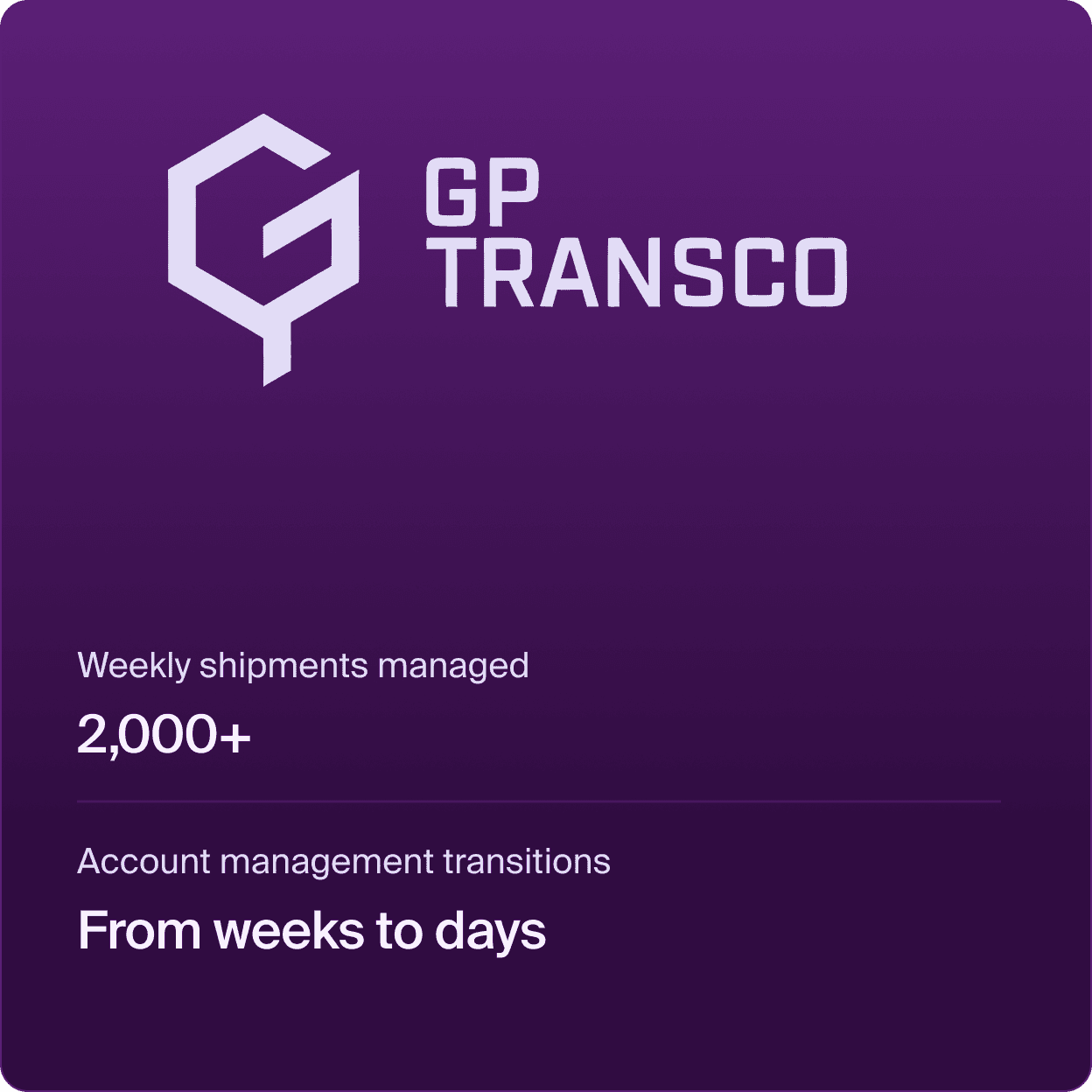
Delivering that experience across 2,000 weekly loads requires coordination well beyond the account team. GP Transco operates more than 500 trucks and 1,600 trailers, supported by teams across three countries. About 80% of the company’s freight is contracted, making consistent service and communication central to maintaining long-term shipper relationships.
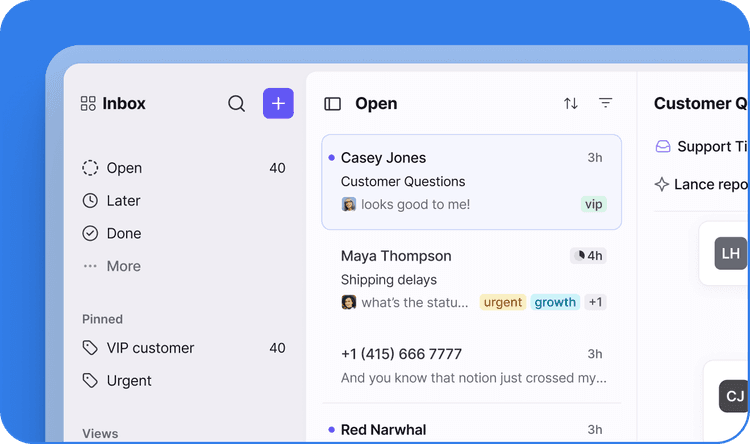
For GP Transco’s account managers, Front serves as the communication layer that connects customer service, operations, after-hours, and accounting teams. Shared inboxes, automated routing, internal comments, and CRM context help employees manage customer conversations without splitting the work across individual inboxes and forwarding chains.
“Front is our system of record for customer communication, the way the TMS is our system of record for loads and the CRM for deals. Long-term, those three layers working together is the strategy: every commitment visible, every issue tracked, every account transferable. Front is the layer that makes our service quality institutional instead of individual.”
Challenge
Keeping account context intact across teams
Each GP Transco account has its own tendering process, tracking requirements, trailer arrangements, escalation procedures, and customer contacts. Because a single load may involve account management, customer service, operations, planning, and accounting, each team needs access to the same account history.
“The complexity isn’t just volume, it’s the number of handoffs per load, across teams, offices, and time zones, and the expectation that every team member has the full picture of an account at any moment,” says Gie.
Before Front, much of that information moved through Outlook mailboxes, distribution lists, forwarded messages, and spreadsheets. Reconstructing an account issue meant piecing together a long email chain or asking colleagues and customers to restate what already happened.
“There wasn’t one good system where account knowledge lived, which is exactly why the company went looking for something better,” says Gie.
Creating clear ownership across teams
As GP Transco expanded its fleet and contracted freight base, customer communication grew faster than the teams responsible for managing it. Tender confirmations, tracking requests, billing questions, claims, detention issues, trailer coordination, and after-hours updates all arrived through email.
Traditional inboxes gave account managers limited visibility into who was responsible for a message or whether another team had already responded. Cross-functional issues were especially difficult because each forwarded message created another version of the conversation. “Customers got answered twice, or not at all, and there was no way to see status or measure response times,” says Gie.
Maintaining relationships through account changes
GP Transco’s customers operate around the clock, while responsibility for an account may move between offices, shifts, or account owners. When customer history lives in individual inboxes, each handoff can slow the response, obscure prior commitments, and force customers to repeat information. PTO and employee turnover make those gaps more visible, because the next person stepping in has to reconstruct the account before they can act.
“Front brings email, collaboration, and workflow into one place. Teams can comment, reply, share, and route conversations without changing how they communicate.”
Solution
Giving every team access to the same conversation
GP Transco now uses Front as the central entry point for customer and operational email.
“Front is the front door for all of our customer communication. Emails come in from different clients at all hours of the day: load tenders, service inquiries, troubleshooting, after-hours issues, plus operational and spot market emails,” says Gie. “All of it flows into shared inboxes where any team member can see a customer’s history and pick right up where a colleague left off.”
Because every team works the same conversation, an account manager can see operations, customer service, accounting, and after-hours activity on their accounts in one place rather than chasing separate threads across departments.
Routing work to the right owner
GP Transco receives a wide range of customer and operational emails throughout the day, each requiring a different response. Front uses routing rules to sort those messages by customer, subject line, or keyword, helping the right team see the work without relying on manual forwarding.
“Routing rules are the backbone. Each type of email automatically lands with the right team, while low-value traffic can be archived before it creates more noise,” says Gie.
Once a conversation reaches the right team, an account manager can pull in colleagues from operations, customer service, or accounting without starting a separate email chain. The discussion stays connected to the original customer message, preserving the decisions and context behind the response. “Internal comments let teams coordinate directly on the thread, so everyone can contribute without splintering the conversation.”
The HubSpot integration adds another layer of context. Account managers can review CRM information from Front while handling the message, giving them a clearer view of the account without moving between systems.
“The employee answering the email has account history and CRM context right there, so they can respond to the customer with the full picture,” Gie says.
Making account knowledge transferable
Front’s communication history complements GP Transco’s library of account Standard Operating Procedures (SOPs). The SOPs establish the expected process, while Front shows the decisions, commitments, exceptions, and customer interactions associated with daily execution. “The combination of documented processes plus communication history in Front is what makes our accounts truly transferable and our service consistent as we grow,” Gie says.
“With Front, less falls through the cracks, communication is faster, and response times with customers are faster, which means our customers are happier and the relationships are stronger.”
Results
More reliable communication at scale
Shared ownership helps GP Transco reduce missed messages and gives customers a smooth experience regardless of which employee responds. “Front helps us deliver faster, more consistent answers from anyone on the team, and proactive communication on issues instead of customers chasing us,” says Gie. “For shippers, working with GP Transco feels like working with one well-informed team rather than a collection of individual inboxes.”
Account transitions reduced from weeks to days
Having an accurate shared conversation history changed how GP Transco handles PTO, staffing changes, and account reassignment. A new account manager taking over an existing relationship can review previous messages, internal comments, and commitments without requiring customers to repeat information.
“A reassignment used to mean weeks of ramp-up and asking customers to repeat themselves. Now the entire account history, every thread, every internal comment, every commitment, is visible to whoever picks it up,” Gie says.
That visibility also gives the after-hours team access to conversations that began earlier in the day and helps employees cover accounts while colleagues are unavailable.
“Coverage during PTO is a non-event: The shared inbox keeps flowing and customers often don’t notice someone is out. Combined with our account SOPs, a new team member can be functional on an account in days instead of weeks.”
New employees can also observe real account activity, review historical context, and participate in active conversations without being copied on every email. “They learn how the business actually runs just by watching it happen in Front,” Gie says.
Stronger continuity for contracted customer relationships
In a freight market where carriers often compete on similar equipment and capacity, GP Transco uses communication quality to strengthen customer relationships.
“Most carriers our size are still running individual inboxes and spreadsheets,” says Gie. “Responding faster, keeping perfect account continuity through turnover and PTO, and showing up to business reviews with organized communication history is a genuine differentiator. It’s part of how we’ve built and defended a book that’s roughly 80% contracted freight, which is rare in this industry.”
GP Transco plans to deepen Front’s role as the company expands, including using AI to triage routine communication, support drafting, identify account risks, and convert support history into reusable knowledge. “New features and possibilities are being added all the time, so our plan is to keep integrating Front deeper into our operations and finding more value as both the platform and our business grow together.”