



A difficult conversation with a boss, an unexpected layoff, or a choice between job offers can leave someone in need of a sounding board. Empower Work provides free, confidential support for workers across the United States navigating those situations. Through text messaging and web chat, trained volunteer peer counselors help people assess their situation and decide how to move forward.
CTO Rajiv Puranik oversees technology across the nonprofit, with a particular focus on the systems that keep its support service running. As Empower Work grows, he looks for ways to help counselors serve more people while preserving the connection at the heart of the service.
“We don’t want to lose our human touch,” Rajiv says. “People come to us with difficult situations at work. They need someone who will listen, help them feel heard, and work through next steps.”
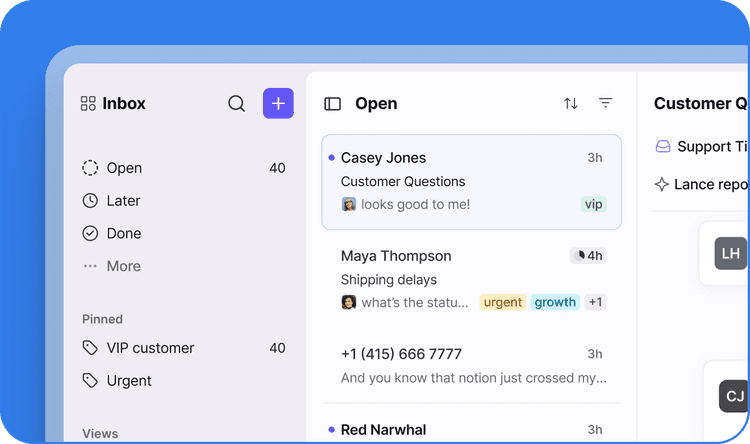
Empower Work uses Front to manage conversations and coordinate volunteers and supervisors. Shared inboxes and internal comments give the team a place to collaborate, while Front’s API and plugins let Empower Work add custom AI tools that summarize conversations, find relevant resources, and give counselors feedback.
“Front is central to our operation. It’s our operating system for communicating with our help seekers.”
Challenge
Coordinating conversations across a volunteer team
Empower Work’s operations center on connecting each person seeking help with a counselor, and making sure that counselor has support throughout the conversation.
Tracy Young, the Data, Research, and Impact Lead, has worked as both a counselor and a backstopper. Backstoppers serve as line supervisors, assign incoming conversations to volunteers, and remain available throughout an exchange.
“Backstoppers help the peer counselors when they have questions, get stuck, or just need a second opinion,” Tracy says.
Conversations can span hours and continue across volunteer shifts, so incoming counselors need a shared history and a useful summary to pick up where a colleague left off. Empower Work follows an established format for those summaries. Standard AI summarizers they piloted didn’t match that structure, so Rajiv needed technology the team could customize for handoffs.
Supporting counselors during sensitive conversations
Counselors need resources and guidance that fit each person’s situation. Someone dealing with job loss might need help finding food resources, while someone facing a workplace dispute might need legal help. Following Empower Work’s counseling methodology, volunteers also need to judge when to explore a problem further and when to help someone consider next steps. Coordinating all those pieces is a challenging logistical puzzle.
Solution
Keeping assignments and coordination in one place
Empower Work has used Front since the early days of its service, giving peer counselors and supervisors one place to manage conversations and coordinate support.
Both communication channels are funneled into Front: SMS messages through Twilio and website conversations through its web chat tool, Chatra. Supervisors use shared inboxes to manage incoming messages and assign them to volunteers. When a conversation needs another counselor, the team can reassign it in the same workspace.
Internal comments let counselors ask questions and coordinate with supervisors alongside the conversation. Different views help people see the conversations relevant to their assignments. “Having an internal chat so you coordinate without leaving the tool is one of the key capabilities Front provides,” Rajiv says.
Front’s rules and tags also help counselors understand how someone reached the service. “Keywords in incoming messages trigger Front rules that give counselors context about how someone reached Empower Work, helping them understand the person’s starting point,” Tracy says. “Templates allow us to get a response back to somebody really quickly.”
“Behind every conversation is a team of people, tools, and resources supporting our peer counselors, allowing them to stay focused on what matters most: making sure every help seeker feels heard, supported, and cared for.”
Bringing custom AI assistance into counselors’ work
As it grew, Empower Work looked to technology to help meet the increasing need without sacrificing the quality of its human support.
Through Front’s external agent architecture, Empower Work brought in its own AI agents to help peer counselors with high-friction, repeatable tasks. Counselors choose from specific, task-oriented options like “Summarize,” “Next Steps,” and “Resources.” At a shift transition, for example, a counselor can select “Summarize” to get a quick picture of where things stand and ensure a smooth handoff. “Resources” surfaces information based on what a help seeker has shared, such as legal guidance. “Next Steps” follows Empower Work’s counseling methodology, helping volunteers decide when to explore someone’s problem more deeply and when to move toward a path forward.
Empower Work is also developing an after-hours AI agent with Front’s capabilities. The agent will allow help seekers to schedule a conversation with a human counselor, then capture the interaction so the counselor can pick up with a warm handoff. It will also remind help seekers when their conversation is about to start.
Results
Supporting a growing service with a small staff and making room for deeper conversations
Empower Work’s conversation volume has grown from about 2 to 33 conversations per day, reaching roughly 16.5 times its original volume. The operation includes approximately 160 to 170 volunteers, 10 contracted supervisors, and 12 staff members.
The average conversation length has grown from about 48 minutes in earlier measurements to roughly 75 minutes. “We have some conversations that go on for hours,” says Tracy. She sees those sustained exchanges as evidence of the connections trained counselors build with people seeking help.
With Front supporting the team behind each conversation, Empower Work can help more people find a way forward through difficult moments.
“We’re always asking how we can better serve both the people who come to us for help and the volunteers who support them. Front gives us the flexibility to build the tools we need to do both.”