



Use quality assurance calibration to align B2B support reviewers, clarify scorecards, and improve service quality across customer conversations.
Quality assurance (QA) reviews are supposed to protect service quality. But too often, evaluators score the same conversation in conflicting ways. One evaluator writes, “The customer representative followed the process correctly,” while another argues, “The rep missed the customer’s real need.”
QA processes like this end up measuring evaluator preference rather than service quality, so reps are left guessing what good support actually looks like. In complex B2B environments, that gap is costly. When customers bring up a problem, it takes companies an average of three hours to coordinate a one-hour fix. That’s why quality assurance calibration has to account for the work behind the reply, not just reply itself.
This article explores what QA calibration is, how the process works, and how to create clearer standards for future reviews.
The definition of calibration in quality assurance
QA calibration standardizes how to measure and score quality. Done well, it makes reviews more consistent and credible, so the same interaction gets the same judgment, regardless of who evaluates it.
In B2B customer support, this process often starts with the call center. But every channel, including email and chat, benefits from quality assurance consistency. When teams know what success looks like across the board, they’re not guessing how to meet expectations, and they deliver good service the first time.
Why QA calibration makes service quality easier to trust
When evaluators apply the same scorecard differently, QA calibration helps keep scoring consistent, making it easier for support reps to understand and trust their feedback.
Front’s support team treats QA as a feedback loop: Evaluators review conversations against shared criteria, reps use that feedback to improve, and teams follow up on recurring issues. The goal is a consistent standard for what good support looks like, rather than a process where reps have to guess what the score means.
That approach gets your team:
Fairer evaluations: Reps get the same score no matter who reviews them.
Clearer expectations: Teams agree on what good service looks like so grading scorecards don’t have confusing gray areas.
More useful coaching: Coaches can create targeted training for individual customer rep needs based on a standardized rubric.
Stronger trust in feedback: People stop worrying about landing a strict grader versus a lenient one, because the rules don’t bend either way.
The payoff isn’t just internal. Conversations go better from the start, because reps already know exactly how to approach the issue in front of them.
How QA calibration turn review gaps into shared rules
Reviewers might already meet to compare scorecards, which gives them some insight into their fellow evaluators’ preferences. But a formal QA process highlights the major gaps between reviewers’ expectations and lays out fixes for each one. Here’s how to run that process well.
1. Set the calibration goal and sample
Start by deciding what review gap you’re trying to close and what sample gives you enough context to judge it fairly.
Take a billing question that needs input from both support and finance. Support reached out; finance never replied. One reviewer marks the response complete. Another flags the missing ownership and follow-up.
Rather than crowning a “winning evaluator,” your job is to define what “good” looks like to close this gap. As a team, you decide support should message billing internally, then include the response from both teams in a single message. Customers get a complete resolution without reading long message chains.
2. Score the same customer against the same criteria
Have every reviewer score the same customer conversation independently, using the same criteria. This step shows whether the rubric leads people to the same conclusion or includes vague rules.
Say a customer got charged twice for one month of services. A rep follows up saying the company will issue a refund. One reviewer sees the message as clear and complete, while another flags that the rep didn’t share a specific timeline.
That difference is the useful part. Discuss the reasoning, not just the score, and pinpoint what the criteria failed to settle.
3. Compare only the gaps that change the evaluation
Focus the discussion on disagreements that actually change the score or the customer outcome. Which gaps are meaningful enough to change how you evaluate the interaction?
For example, reviewers may disagree on whether ownership was clear. That matters if the customer could leave the conversation unsure who’s responsible for the next step. But debating minor wording differences won’t improve the review process.
Keep the conversation anchored to customer impact and the rubric, then agree on which interpretation should win. That way, you prioritize the high-impact gap. The agreed interpretation and a clear reason behind it gives your team a map to apply again.
4. Capture the shared rule reviewers will use next time
Every calibration discussion should end in a rule, not just a resolved disagreement.
Say your team agrees a billing follow-up only earns full credit when it names the owner, confirms the next step, and gives a specific timeline. That’s a rule someone can apply cold on the next review, whereas “reviewers agreed” isn’t.
Write the rule in plain language, tied to the rubric, so it’s easy to apply it consistently. The shared rule becomes part of the QA guidance in future reviews.
Where QA calibration should change the scorecard
Say you selected sample support tickets for reviews and ran blind evaluations. Then, you met to compare scores and rewrite rubrics.
On paper, your team did everything right to align reviewers. But the calibration isn’t improving. And you’re still among the 64% that reported a customer-facing coordination failure in the past three months. What went wrong?
You measured the interactions’ tone and accuracy but forgot to account for the work behind the reply. To turn this around, you need to look for signals like increased reviewer agreement, a decrease in repeated scoring gaps, and more specific recurring coaching themes. Ultimately, QA calibration isn’t about solving a single disagreement; it’s about making future reviews easier.
Front keeps QA calibration tied to the work behind every score
Every customer conversation and subsequent review forms a pattern. Successful QA calibration starts with reviewing these patterns and creating shared criteria evaluators can all agree on.
But getting on the same page takes more than just agreeing on a new standard. Businesses also need systems to improve the review process. B2B teams use Front, the customer operations platform, to connect QA calibration with context and ownership.
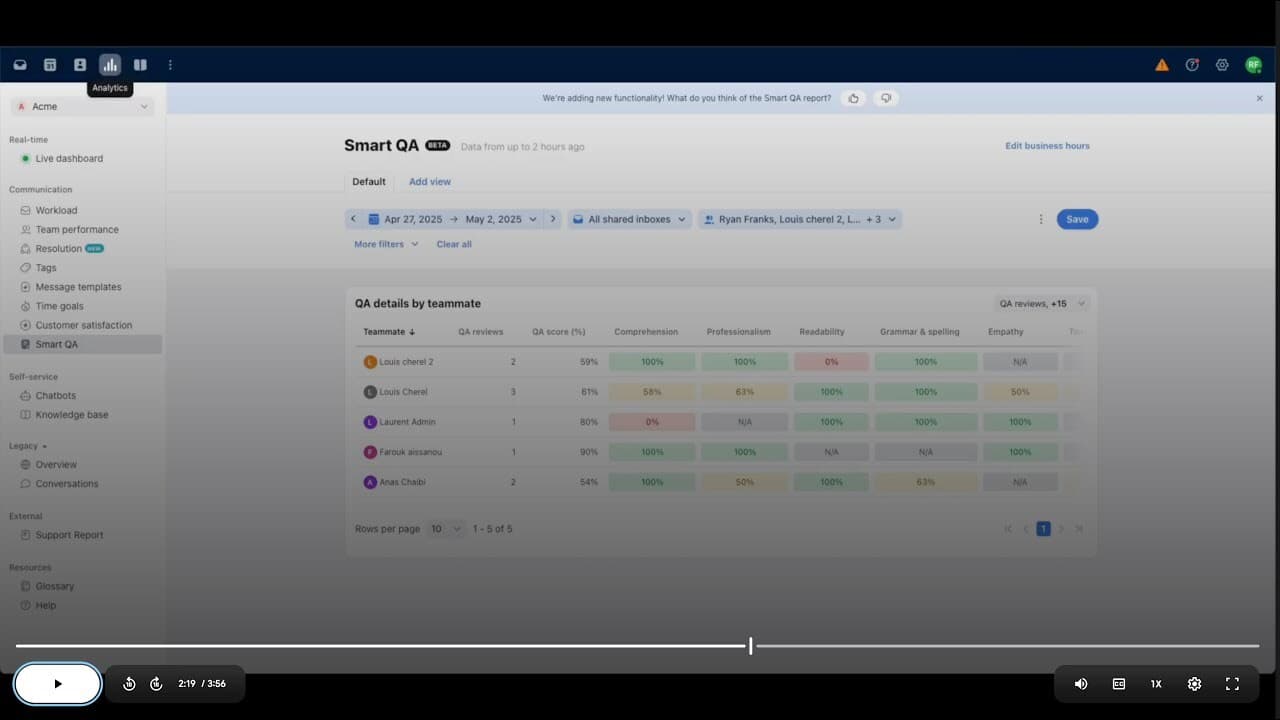
Smart QA reviews every customer ticket and evaluates them against AI-powered scorecards. You set the standards and tell the platform how to interpret results, expanding visibility without the manual grind. Teams can still override AI-generated scorecards, so human judgment is always at the core.
Here’s how Smart QA works:
Request a demo to see it in action.
FAQ
How often should teams run QA calibration sessions?
B2B customer service teams should run QA calibration sessions monthly. This cadence keeps team scores accurate without taking too much time away from daily work. For a new scorecard or program, shifting to weekly or bi-weekly sessions helps build a shared scoring mindset faster.
Who should participate in QA calibration?
QA evaluators, team leaders and supervisors, operations managers, and training staff should be included in QA calibration sessions to ensure score consistency and align on standards.
What is the difference between QA calibration and quality control?
The quality assurance calibration process focuses on fair and uniform evaluations, while quality control protects client SLAs and contract standards. QA calibration eliminates personal bias and subjective scoring so each customer rep receives fair, consistent scores regardless of who views them. In a customer support context, quality control focuses on individual rep outputs and performance.