


In freight brokerage, the margin between winning and losing a deal is measured in minutes.
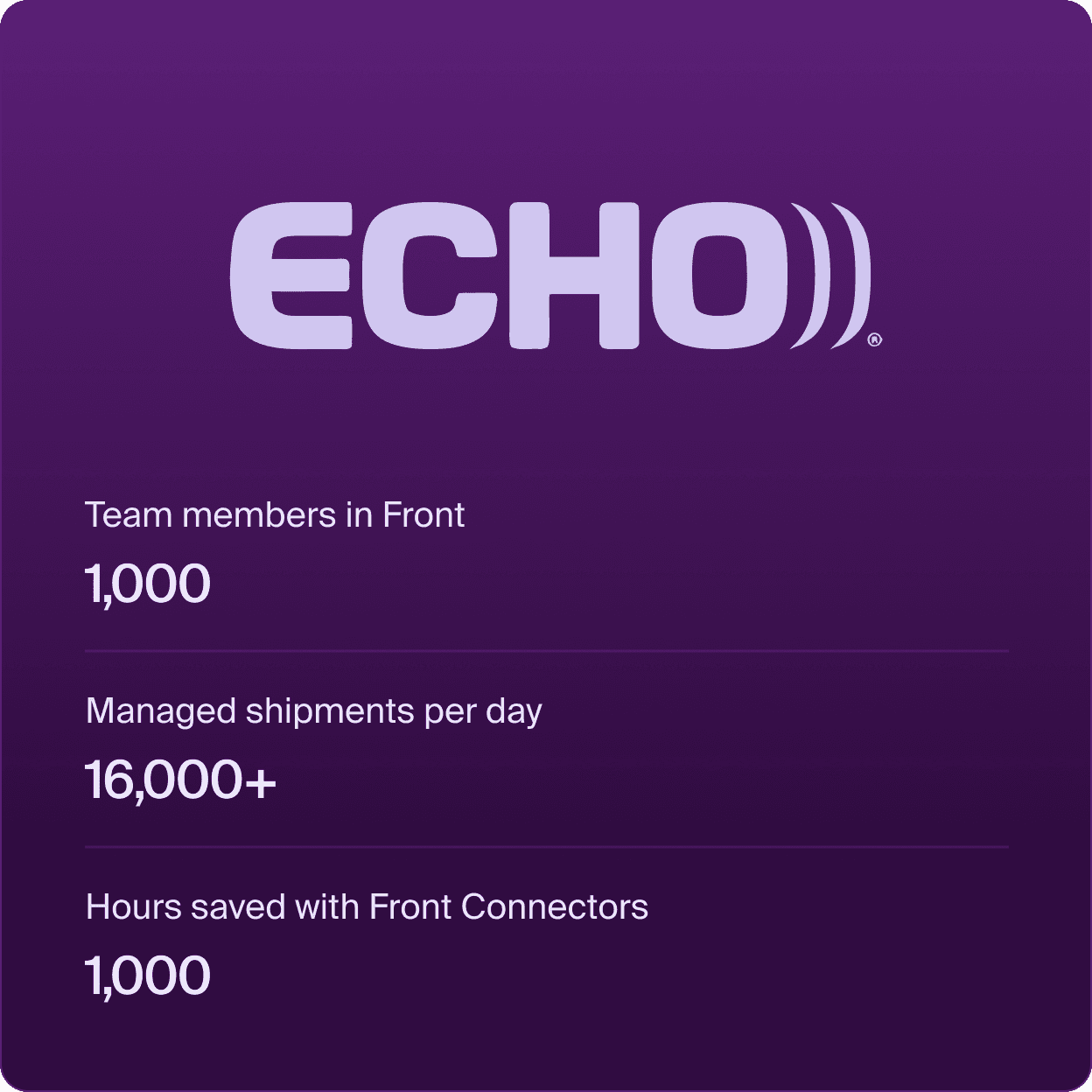
Echo Global Logistics knows this better than almost anyone. Echo is the fourth-largest freight broker in the United States, moving more than 16,000 shipments a day across truck, air, rail, and every mode in between.
Founded in 2005, Echo has grown into a $5.2 billion full supply chain solution with more than 3,500 employees across 60-plus locations in North America. Each shipment goes through over 100 touchpoints, from quoting and order entry to tracking, exception handling, and billing. With email at the center of customer communication, Echo uses Front to connect conversations with shipment data, helping teams respond faster and deliver the service that sets them apart.
“In logistics, response time isn’t measured in hours, it’s measured in minutes. Miss a quote window, and you may lose the business. Take too long to update a customer on their shipment, and you may damage the relationship.”
Challenge
A third of the workday spent in email
Echo’s team spends nearly 30% of their time managing email — about as much as they spend working in their proprietary transportation management system (TMS).
“We’ve made a huge investment in our TMS to have one of the best platforms in the space,” says CIO Zach Jecklin. “But our people spend just as much time in email. The gap between systems was costing us.”
Communication ran through personal Outlook setups and shared distribution lists managed by a help desk. Every employee had their own configuration, their own folder logic, and their own way of managing the flood of inbound requests.
“It was really siloed,” says Danielle Brod, who leads Change Management and oversaw Front adoption across Echo. “Onboarding a new employee meant asking them to reverse-engineer a colleague’s Outlook setup. It was not a scalable system.”
Echo could not continue running a 16,000-shipment-a-day operation out of disconnected inboxes and processes that couldn’t scale.
“There wasn’t one aha moment,” Zach says. “It was more about asking what little things we could do to stand out in a packed field of competitors. The little things that compound into something big are what separates you from the competition.”
Shipment context trapped in the TMS
At Echo’s scale, even a few extra steps in every customer interaction can create significant operational drag. Handling an email about a shipment meant leaving the inbox, opening Echo’s proprietary TMS, searching for the load ID, finding the relevant details, and bringing that context back into the conversation. Repeated across thousands of emails and hundreds of users each day, those extra steps added up to hours of lost productivity.
Solution
Scaling collaborative email across teams
An operational team that had outgrown Outlook’s ability to handle high-volume, collaborative email adopted Front in 2019. As other teams saw the results, demand grew and adoption spread organically across the company.
“More teams wanted the same access,” says Danielle. “They were looking for a better way to solve the problems they had been using Outlook to work around,” Danielle says.
Today, roughly 1,000 of Echo’s 3,500 employees use Front. Teams get a sandbox environment to move messages, test features, and start reshaping how they work. Once they find their footing, Danielle steps back.
“Front is so intuitive that once teams start with that foundation, they run with it. They come back telling me what they’ve figured out on their own,” she says.
Bringing shipment data into every conversation
Front Connectors bridge the gap between Front and Echo’s proprietary TMS by surfacing shipment data directly inside email conversations.
Connectors transform load ID emails into structured shipment records that appear directly in the conversation. With no tabs to switch between or details to copy and paste, employees can move from request to resolution without losing context.
“For us, it’s about creating synergy between those two systems,” Zach says. “We can either bring work into the TMS or bring TMS data into the email. That’s why Connectors are so important.”
As adoption grew, teams asked to see more TMS fields in emails. Echo’s technology team expanded the Connector endpoint, making more shipment data available and driving even broader usage.
“Our tech team continued enhancing the Connector endpoint to bring more data into Front and make it valuable for teams across the company,” says Danielle.
The impact has been especially significant for Echo’s after-hours team. Freight keeps moving long after the workday ends, and this team steps in to support customers once their primary account teams have signed off.
“The Connector tags each message by account, so the after-hours team can quickly find the right SOP and provide specialized service,” Danielle says. “That’s been an incredible time-saver.”
“Bringing key shipment details directly into the inbox has made a measurable difference. Each interaction may save only seconds, but at our scale, those seconds add up to hundreds of productivity hours every month.”
Results
1,000 hours back and counting
Within 15 months of deploying Front Connectors, Echo tracked nearly 1,000 hours saved across Front users. As adoption continues to expand, those savings grow month over month.
Less time toggling between systems means more time focused on what sets the company apart: service, speed, and the kind of responsiveness that wins business.
Danielle’s team is already exploring how to take Front further, using the shipment data already surfaced in conversations to automatically route emails to the right person. “We’ve proven the time savings. The next step is closing that gap and making the speed we’ve gained on the inside even more visible on the outside,” she says.
For the teams using Front every day, it’s fundamental to how they work. “People tell me they genuinely couldn’t do their job today without Front. The way we work now just wouldn’t be possible without it,” Danielle says.