


Read a breakdown of the top customer service software for small businesses. Find out their strengths, limitations, and pricing to find the right fit.
A brand-new business might not need customer service software with all the bells and whistles. But as a B2B company grows, teams need software that coordinates work across people and systems, or delayed responses and duplicate work start to pile up.
The tools you choose shape not just efficiency but also your customer trust and brand perception. In Front’s State of Service Expectations report, 78% of customers said they’re more loyal to brands they trust for customer service, and 80% said service quality shapes their overall perception of a brand. Growing teams need tools that maintain consistent customer service even as operations become more complex.
Here’s a breakdown of the top customer service platforms for small businesses, with their strengths, limitations, and pricing, and how to evaluate them for where your team is headed.
Why growing businesses need well-equipped software
Customer service platforms typically include a queue of incoming tickets. But a growing B2B customer service operation needs more than a queue; it needs software that lets teams coordinate across shared inboxes and internal handoffs while keeping customer context visible. Here’s why.
Unmanaged email workflows slow operations
Early on, email alone can work. But when a conversation needs two or three people, each of them needs to see what’s already happened. Without shared context from CRM records and past conversations, every handoff adds a delay.
The right software enables growth
Evaluating help desk software based on current ticket volume can cost you later. A team of five handling 200 conversations a month may get by with a shared inbox or a basic help desk. Double that team and spread conversations across departments, and a knowledge base and workflow automation start to matter a lot more.
The best customer service software for small businesses
Several types of customer service systems exist, from basic ticketing systems to full customer operations platforms. The right choice of customer service software depends on the company’s operational complexity, collaboration requirements, and expected growth. Here are five options for teams at different stages of growth.
1. Front
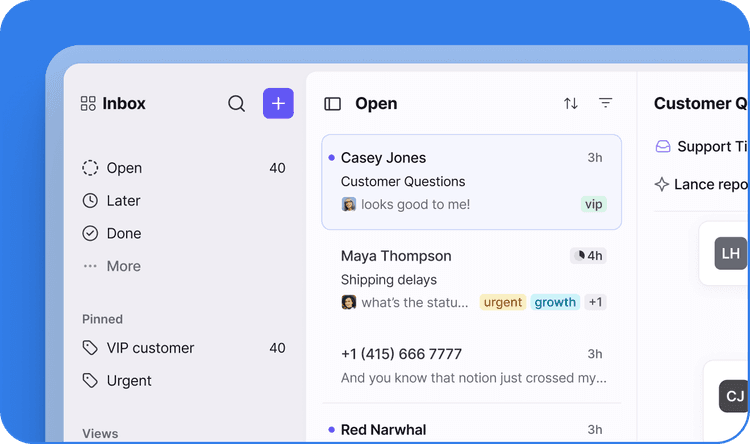
Front is a customer operations platform that unifies email, chat, SMS, and social into shared inboxes. It works well for companies that have outgrown basic customer service tools and need to be able to smoothly coordinate conversations across teams and systems.
Best for: Front is ideal for growing B2B teams that need cross-team collaboration in one workspace.
Key strengths:
Real-time collaboration: Team members can leave internal comments and assign ownership directly within a customer thread.
Operational visibility: Managers and team leads get a complete, updated view of open conversations and assigned ownership across the team.
Limitations: Small businesses that are just starting out may not make use of all the features.
Pricing: Front offers a 14-day free trial. Paid plans range in price from $25 per seat per month to $105 per seat per month.
2. HubSpot Service Hub
HubSpot Service Hub is the customer service feature in the HubSpot platform, offering ticketing, live chat, a knowledge base, and AI-powered ticket routing alongside HubSpot’s CRM.
Best for: It suits teams already using HubSpot CRM that want service data connected to sales workflows.
Key strengths:
Unified data across HubSpot ecosystem: Support representatives can see a customer’s purchase history, marketing interactions, open deals, and previous tickets in one view.
Retention metrics: Service Hub includes health scores and a customer success workspace that connects service activity to retention metrics.
Limitations: HubSpot’s pricing gets expensive as teams grow. Reviewers note that its knowledge base page customization is limited compared to dedicated knowledge management tools.
Pricing: HubSpot Service Hub offers a free plan with basic ticketing and live chat messaging for up to two users and a 14-day free trial of AI features. Paid plans range from $7 per seat per month to $150 per seat per month.
3. Freshdesk
Freshdesk, built by Freshworks, is a help desk software platform designed for structured ticket management with automation rules, service-level agreement (SLA) tracking, and a knowledge base.
Best for: Freshdesk works best for mid-market support teams that need structured ticketing with automation and SLA management.
Key strengths:
Automated ticket management: Freshdesk’s ticket routing and SLA policies help support teams organize and prioritize incoming requests without manual sorting, which saves time as ticket volume grows.
Collision detection: Freshdesk shows when another support rep is already viewing or replying to the same ticket in real time, which prevents two support reps from sending the same or different messages to the same customer.
Limitations: Several of Freshdesk’s more useful capabilities, like intelligent routing and AI Copilot, require the Pro or Enterprise tier, which can be a barrier for smaller teams on tighter budgets.
Pricing: Freshdesk offers a 14-day free trial with access to enterprise-level features. Paid plans range from $19 per user per month to $89 per user per month.
4. Zoho Desk
Zoho Desk is a cloud-based customer service software that handles customer inquiries across email, chat, social media, and phone.
Best for: Zoho Desk suits budget-conscious teams that need affordable and scalable ticketing.
Key strengths:
Free plan: Zoho Desk has a free plan for up to three users with email ticketing.
Deep integration with Zoho suite: Teams that already use Zoho CRM can see customer details and deal history directly inside support tickets without leaving the help desk interface.
Limitations: Reviewers report that the number of settings and configuration options can be difficult to manage during initial setup.
Pricing: Zoho Desk offers a free plan for up to three users and a 15-day free trial. Paid plans range from $7 per user per month to $40 per user per month.
5. Gorgias
Gorgias is a conversational AI platform built specifically for e-commerce brands, with native integrations for Shopify, BigCommerce, and Magento.
Best for: Gorgias works well for e-commerce brands on Shopify or BigCommerce that need commerce-integrated support.
Key strengths:
Native e-commerce integration: Support reps can see a customer’s full order history and transaction details directly in the ticket view.
Flexible automation with rules: Customer support managers can build workflows around their specific business logic using tags and rules.
Limitations: Gorgias uses ticket-based pricing instead of a flat per-user fee, so costs add up with conversation volume and can spike unpredictably during busy periods (like product launches).
Pricing: Plans range from $40 per month to $1,430 per month.
Choose software that won’t hinder your growth
Feature checklists of customer service software applications tell you what a platform can do, but they don’t tell you whether a platform fits the way your team works today or how you need to work as you grow. To read between the lines, keep the following in mind:
Collaboration needs: If customer inquiries regularly involve handoffs between teams, the platform needs to support shared ownership, internal comments, and visibility across teams.
Automation features: Front’s State of Service Expectations report found 60% of customers would pay more for faster response times, but 49% would stop doing business with brands relying entirely on AI. Strike the right balance with a platform that lets you use AI to speed up customer service while keeping human oversight.
Integration: Determine which channels and integrations you need. A small B2B SaaS financial services firm may need email and voice today but grow to need live chat and a customer portal next quarter.
Long-term scalability: Enterprise customer service software that takes two weeks to deploy but can’t handle cross-department workflows at 50 seats requires you to switch platforms again as you scale.
Grow past small-business customer service software with Front
Front’s customer operations platform is built for growing B2B organizations. When customer context lives in separate systems, coordination becomes a real challenge. Front keeps teams, tools, and customer conversations connected, helping teams maintain consistent service as they scale.
Mixam, an online printing company, centralized its customer communication in Front to give support reps better visibility into customer conversations. The company’s first response time dropped by 60% while email and call inquiries fell by 16%. Support reps also gained the context they needed to resolve issues without switching between platforms.
As you scale, the goal isn’t just handling more requests — it’s handling more volume and complexity without piling on coordination work. Front gives teams the visibility and tools to keep work moving and the experience consistent.
Request a demo to see how Front helps you grow customer operations without losing visibility or control.