


Enterprise help desk software helps teams collaborate with ease. Compare service desk applications to choose the best option for your B2B operations.
In a large organization, customer work never stays put. A billing question turns into a product escalation. An onboarding request pulls in sales, success, and operations. Every one of those handoffs is a chance to drop the thread.
And teams drop it more often than they’d like to. In Front’s Coordination Tax report, 64% of companies said they’d experienced at least one customer-facing coordination failure in the last three months.
Enterprise help desk software exists to prevent similar failures. It helps large companies that constantly pass work between teams keep the context intact, so everyone knows who owns what and customers never have to repeat themselves.
Here are the leading enterprise help desk software options, with their strengths, limitations, and pricing, to help you find the right fit
Why enterprise customer support requires more than ticket management
Enterprise help desk software is a category of customer service software built to coordinate work across departments and connected systems.
Standard help desks handle only individual inquiries. This often leads to requests getting bounced around for weeks, Front’s Coordination Tax report found. Larger companies need more, for three reasons.
Customer work rarely stays within one team
A warranty claim might start in support, need sign-off from operations, and then loop in account management for follow-up. If those teams work in a system with no shared visibility, the customer re-explains the issue at every handoff. Software with clear escalation management and conversation ownership lets teams pass work along without making the customer start over.
Context determines service quality
A rep handling a high-value account is far faster and more accurate with customer history, customer relationship management (CRM) records, internal notes, and prior conversations in one view. Without that context, response time and accuracy slip.
Operational visibility scales better than manual oversight
Once a team is fielding real volume, no manager can maintain quality by reading every conversation. Reporting on response times and service-level agreement (SLA) compliance lets leaders catch problems early, and workflow automation and rule-based routing take the manual overhead out of staying consistent as volume climbs.
The best enterprise help desk software
Here’s a breakdown of the best help desk software solutions for enterprises. Each of these help desk software examples serves different operational priorities, from AI-first automation to deep CRM integration.
1. Front
Front handles the coordination behind complex B2B customer relationships. More than 9,300 companies trust the platform for coordinating customer operations across teams and channels.
Best for: B2B teams managing complex cross-functional customer operations, where work spans multiple departments and communication channels
Key strengths:
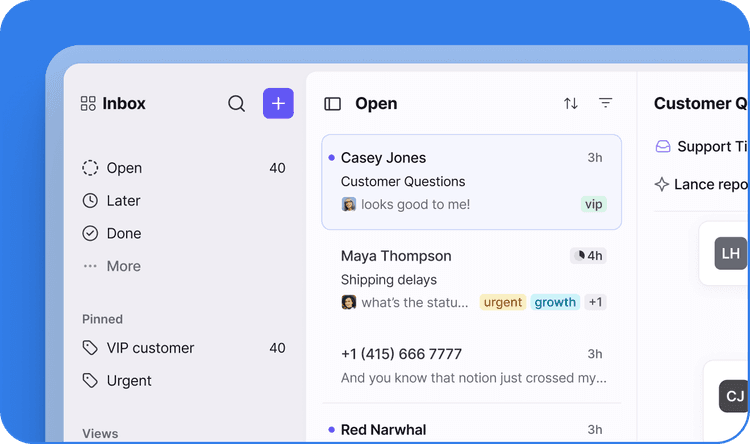
In-conversation team collaboration: Internal comments, shared drafts, and conversation assignments let multiple teams work on the same customer issue without forwarding threads or losing context.
Operational visibility for leaders: Managers can see what’s open, who owns each conversation, and what needs follow-up without building complex reports from scratch.
Limitations: Front is designed for B2B complexity, so smaller B2C teams may not make use of the full feature set.
Pricing: Plans range in price from $25 per seat per month (up to 10 seats) to $105 per seat per month for the Enterprise plan. Copilot, Smart QA, and Smart CSAT are included in Enterprise or available as add-ons. Autopilot starts at $0.05 per conversation.
2. Zendesk
Zendesk is a help desk platform built around a ticket-centric workflow model with deep configuration options. Its app marketplace extends the platform’s capabilities with integrations for CRM, analytics, workforce management, and quality assurance.
Best for: Large support teams that need deep workflow customization and integration capabilities
Key strengths:
Multi-channel support view: Email, chat, social media, and phone interactions consolidate into a single ticketing system with quality assurance and workforce management features for consistency at scale.
Deep reporting and analytics: Zendesk Explore allows managers to build detailed dashboards for analyzing ticket volume, resolution times, and satisfaction scores.
Limitations: Reviewers note that the number of settings and menu layers makes initial setup and ongoing administration challenging for new admins.
Pricing: Plans range in price from $19 per user per month to $115 per user per month, with add-ons available. The pricing for an Enterprise + Co-Pilot plan — which includes the most proactive AI assistant — is available on request.
3. Freshdesk
Freshdesk by Freshworks is designed for teams that want to get started without a long implementation cycle. The platform emphasizes ease of use and provides ticketing automation, knowledge base, and omnichannel support across all tiers.
Best for: Growing support teams looking for fast onboarding, strong value, and accessible automation
Key strengths:
Accessible ticket automation: Routing rules and SLA management can save time on repetitive work.
Fast onboarding and short learning curve: Reviewers find that the platform’s clean interface keeps ticket management and team collaboration straightforward.
Limitations: Deeper analytics, AI co-pilot, skill-based routing, and sandbox environments require upgrades.
Pricing: The subscription tiers range from $19 per user per month to $89 per user per month. All paid plans include 500 AI agent sessions, with additional sessions available as an add-on at $49 for 100 sessions.
4. Agentforce Service
Agentforce Service (formerly Salesforce Service Cloud) connects customer service with the broader Salesforce CRM. This gives support teams access to account data, sales history, and customer engagement records alongside every case.
Best for: Enterprises already invested in the Salesforce ecosystem that need a fully integrated service management solution
Key strengths:
360-degree customer view through CRM integration: Organizations using Salesforce can see past purchases and prior cases within the service console.
Automation through Flows and case routing: Admins can configure escalation rules to automate repetitive support work and enforce SLA compliance across teams.
Limitations: It has a steep learning curve and the cost of useful add-ons quickly add up, according to one reviewer.
Pricing: The pricing ranges from $25 per user per month for the most basic plan to $550 per user per month for the highest-tier plan with built-in AI capabilities and unlimited usage.
5. Fin (Intercom)
Fin is Intercom’s AI-powered support platform. It analyzes existing knowledge base and help center content, then handles customer conversations autonomously or escalates to a human based on predefined rules.
Best for: Teams prioritizing AI-first customer support automation
Key strengths:
AI-first workflow execution: Fin automatically follows configured workflows and takes actions across integrated tools, processes that traditional automated response systems handle through rigid decision trees.
Cross-platform deployment: Fin works as a standalone solution or connects with help desk solutions like Zendesk and Salesforce, so teams can add AI resolution capabilities without replacing their current platform or retraining support representatives.
Limitations: Reviewers say that Fin handles common questions well, but in highly specific or company-unique scenarios, the AI can return inaccurate answers.
Pricing: You can connect Fin AI agent to your current help desk for $0.99 per outcome, with a 50 outcome per month minimum. Intercom help desk seats cost $19 per seat per month. A co-pilot add-on costs $35 per user per month.
6. Zoho Desk
Zoho Desk provides multi-channel ticketing, workflow automation, and knowledge base tools at a price point well below most enterprise competitors. It integrates easily with other Zoho products, like Zoho CRM and Zoho Analytics.
Best for: Budget-conscious teams that want deep integration with the broader Zoho ecosystem
Key strengths:
Deep Zoho ecosystem integration: Organizations using Zoho CRM, Zoho Projects, or other Zoho applications benefit from native data sync and multi-department ticketing without third-party middleware.
Reliable ticket automation: Teams can automate email-to-ticket conversion, assignment rules, and canned responses.
Limitations: Reviewers dislike that Zoho Desk spreads configuration options across different sections of the interface, so making a simple change to a workflow rule can mean clicking through several layers of menus.
Pricing: Zoho Desk offers a free plan for up to three users. Paid subscription tiers range from $7 per user per month to $40 per user per month.
How to choose the right enterprise help desk software
Switching enterprise service desk applications can be expensive and time-consuming, so it’s worth taking the guesswork out. Weigh these factors:
Organizational complexity and collaboration: If your support specialists regularly involve other departments to resolve issues, you need a tool with clear ownership built in.
AI and integrations: Look at how AI and workflow automation support your existing processes while maintaining human oversight on complex issues. The right AI customer service approach supports your team’s judgment.
Implementation and maintainability: Ask how long it takes to go from purchase to productive use and evaluate whether you need dedicated admin resources or consulting support.
Front: Enterprise help desk software built for cross-team coordination
Front is built for enterprise organizations where customer work spans multiple teams and channels. It keeps customer conversations, team collaboration, and workflow automation in one coordinated workspace, so everyone works from the same context.
GLT Logistics, a logistics provider operating in North America, processes more than 14,000 customer emails each month. After adopting Front for better conversation visibility and clearer ownership, the company cut response time by 83%.
The more teams and channels your work touches, the more that coordination gap has an impact. Ready to see how Front can keep your team in sync? Request a personalized demo now.