


HubSpot, Fin, and Front take different approaches to customer work. Learn which model aligns best with the way your team operates.
Customer conversations are only half the battle for B2B teams.
HubSpot, Fin, and Front all offer capable tools for communicating with customers and resolving issues. But they take different approaches to everything that happens around those conversations, including coordination, ownership, visibility, and follow-up.
Front’s Coordination Tax report found that the typical B2B company spends nearly three hours coordinating for every hour spent solving customer problems. How a platform handles work across teams matters just as much as its core communication features.
This comparison of HubSpot vs. Fin vs. Front looks beyond surface-level capabilities to examine how each platform supports customer work.
HubSpot vs. Fin vs. Front: The quick read
On the surface, all three are solid customer communication platforms with workflow automation and collaboration tools that help customer-facing teams get work done.
The differences show up in how each platform is designed to handle customer work and which teams each model is best suited to support.
How HubSpot, Fin, and Front approach customer communication
The three tools put the weight in different places: CRM data, conversational support, or the operational work around the conversation. Here’s a closer look at what each platform offers.
What is Front? A customer operations platform built around the conversation
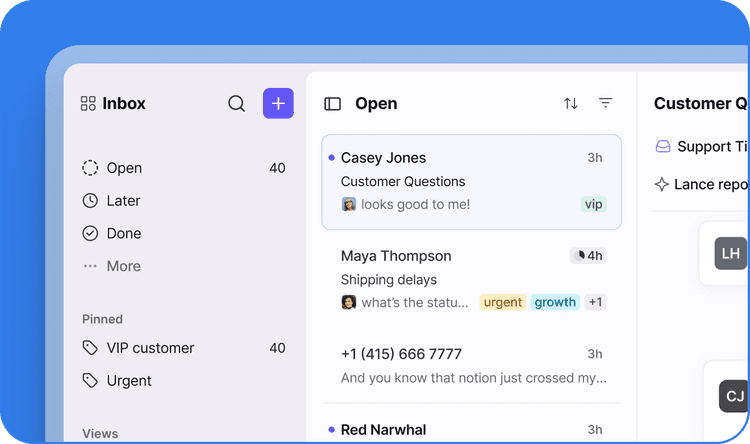
Front is the customer operations platform built for B2B teams that need customer conversations and the work behind them to stay connected. The platform combines individual emails, shared queues, and Slack-like collaboration in a single system, giving teams a shared place to collaborate, coordinate, and follow up.
Front’s model fits organizations that need reliable access to customer context and clear ownership as work moves across teams. It’s the only solution where teams can collaborate around the customer instead of working from siloed support queues.
What is HubSpot? A CRM-first platform for customer data and lifecycle workflows
HubSpot offers a ticketing system closely integrated with its CRM, marketing, and sales tools. It centers work around managing relationships across the whole customer lifecycle, with customer interactions stored and connected within its CRM.
HubSpot’s model is well-suited to organizations that want to put the focus on broad customer relationship management instead of customer service specifically.
What is Fin? An AI-powered customer service platform for support and product engagement
Fin, formerly known as Intercom, is an AI-powered customer service platform built around conversational support, live chat, in-app messaging, support tickets, automation, and AI-assisted service. Its approach puts AI at the center of customer support, helping teams automate responses and resolve customer questions at scale.
Fin’s model is well-suited for teams that prioritize chat-first support, in-app engagement, and product-led growth.
Where HubSpot, Fin, and Front differ in day-to-day customer work
In B2B customer service, the right platform is about more than a feature list. It’s about how well the platform supports the work that keeps customer issues moving, especially when issues require coordination across teams.
This section explores what each platform offers as customer work moves across teams, tools, and follow-ups.
Customer communication and support
Front brings email, chat, and other communication channels together in shared inboxes, giving teams a single workspace for managing customer conversations and collaborating on them. HubSpot connects customer communication to sales and marketing conversations as part of a unified CRM record, while Fin emphasizes real-time, conversational support through live chat and messaging, with a focus on fast resolution and AI-assisted self-service.
What the tradeoff means for B2B teams: Front is a strong fit for teams that need to collaborate across both individual and shared communication channels, while HubSpot is less about having the conversations and more about holding the record. Fin is suited for teams more focused on fast responses and high-volume customer interactions.
CRM and customer context
Front and Fin both integrate with popular CRM tools to bring customer context into conversations. HubSpot, on the other hand, offers a centralized CRM where every interaction is stored in a single customer profile.
What the tradeoff means for B2B teams: HubSpot provides the most CRM-centric approach of the three systems, while Front and Fin bring essential context into the customer conversation without making the CRM itself the primary workspace.
Automation and AI
Front offers automation designed for multi-step, multi-system, and multi-department workflows. Its AI tools automate routine tasks like routing, assignments, and answering repetitive queries, while handing complex tasks to human teams with all the necessary context. HubSpot offers Agent Hub and AI agents that use CRM data to automate tasks across marketing, sales, and customer service. Fin uses AI for case deflection, with its Fin AI Agent handling an average of 76% of customer conversations on its own.
What the tradeoff means for B2B teams: Fin handles routine queries well, but needs to hand off to another platform to handle complex B2B issues. Front prioritizes more control and context, and HubSpot has automation that’s compatible with its different product suites.
When evaluating AI customer service software, keep in mind that more automation is not necessarily better. Front’s Coordination Tax research found that 71% of B2B companies faced at least one significant AI issue in the past three months, including additional coordination work, lost context during handoffs, and incorrect routing.
Team collaboration and workflow management
Front enables cross-team collaboration directly within customer conversations via shared inboxes, internal comments, and assignments. HubSpot emphasizes coordination across sales, marketing, customer success, and customer support via a shared CRM. Fin offers AI-assisted routing, escalation, and assignment for faster workflows within the customer support team.
What the tradeoff means for B2B teams: Front is best for coordinating work on complex issues and maintaining clear ownership across handoffs. HubSpot is well suited to organizations that need to update shared records between customer service, sales, and marketing, while Fin uses automation and AI to smooth customer support workflows.
Focus on ownership and handoffs if your team handles customer work across different teams. Front’s Coordination Tax report found that 64% of companies reported at least one customer-facing coordination failure in the past three months, including inconsistent answers, lost context, customers repeating themselves, and missed messages due to unclear ownership.
Reporting and visibility
Front’s customer service analytics help teams track the time spent on coordination work across teams, showing how the workload is distributed and where bottlenecks occur. HubSpot offers a report builder that draws on CRM data, while Fin emphasizes support analytics like ticket volume, response time, and customer satisfaction.
What the tradeoff means for B2B teams: Choose the type of reporting that best matches your operating model and that shows not just the outcomes but also the work required to reach them. Front’s Coordination Tax research found that 42% of companies don’t track coordination at all, and only 5% see the complete picture across handoffs, coordination time, and duplicate work.
When to choose HubSpot, Fin, or Front for your customer workflow
Each platform takes a different approach to customer work. Here’s how to choose between them based on how your team operates and how much coordination is required.
Choose Front if…
Front is a strong fit for B2B teams managing complex customer conversations across different teams and tools. Its collaboration tools help teams track issues, share information, work together using shared context, and stay accountable during handoffs. Its platform is built to minimize coordination time with AI-powered automation tools that keep context and ownership clear at all times.
Choose Fin if…
Fin is a good choice for teams that prioritize AI-powered customer support through conversational channels like live chat and in-app messaging. Its Fin AI Agent and workflow automation allow teams to manage growing volumes of customer inquiries efficiently and keep response times fast as the company scales.
Choose HubSpot if…
HubSpot is well-suited for companies that want an all-in-one CRM tool as opposed to a best-in-class customer service platform. Its CRM provides a shared source of customer data across teams, helping customer-facing teams maintain visibility into the customer relationship and share customer records in a single system.
Bring HubSpot and Fin into one customer communication workflow with Front
HubSpot, Fin, and Front have strong capabilities, so some teams use all three as part of the same workflow. Front’s HubSpot and Fin integrations let you connect CRM context, chat messages, customer profile data, and follow-up work together in one place.
For example, you can use HubSpot as your CRM and Fin as your AI agent, while Front handles the complex customer work and escalations. This coordination layer is critical in B2B customer service: Front’s Coordination Tax report found that 14% of companies have built coordination infrastructure to connect this work, rather than relying solely on task automation.
Request a demo now to see how Front keeps customer conversations, tools, and teams in sync.