



Compare SaaS ticketing systems for B2B teams and see why conversation-first support keeps context, ownership, and follow-up connected.
A growing logistics company opens six new warehouses, but its customer support software doesn’t keep pace. Customer emails keep piling up, and no one can tell who is handling what. Chaos follows as the company fields thousands of messages each day across individual inboxes.
A SaaS ticketing system can bring that volume under control. But traditional systems don’t always preserve customer context, clarify ownership, or help teams follow up consistently as work moves across departments. Upgrading to a new system can solve one problem and create another.
It’s a common pain point: Front’s Coordination Tax report found that the typical B2B company spends nearly three hours coordinating for every hour spent solving customer problems. When upgrading to a new ticketing system, you need to look for one that cuts coordination time, not just ticket volume.
Here are five leading SaaS service desk tools, guidance on which platforms fit different service models, and when to choose ticket-first vs. conversation-first support.
How a SaaS ticketing system handles complex issues
A SaaS ticketing system is software that lets companies collect, assign, prioritize, track, and resolve customer support requests across channels.
Say a customer hits a technical problem when trying to integrate their dashboard with a third-party tool. The customer sends an email asking for help, and the system automatically creates a ticket that contains all the details of the request.
Support does initial troubleshooting but can’t resolve the issue, so the ticket moves to the development team for further investigation. Each team updates the ticket as they work, logging status and next steps. Once developers resolve the issue, support notifies the customer and closes the ticket.
Choosing a suitable SaaS ticketing system
Most ticketing systems handle basic ticket management without much trouble. What matters for B2B customer service is whether every team can see who owns a given request as it moves across people and tools. Look for these key features.
Omnichannel intake that routes work without losing the thread
B2B customers reach out through email, live chat, and Slack — often all three on the same issue. An omnichannel ticketing system routes each inquiry to the right team automatically and escalates based on rules you set, not manual triage.
The system should also make it easy to track a request as it moves using tools like tags and internal comments, so increasing volume doesn’t mean losing track of who owns what.
Customer context, ownership, and SLAs that stay visible
As teams work on an issue together, they need the full picture: past conversations, account health, current status, who owns it, and where things stand against your surface-level agreement (SLA) targets.
When all of this information is visible and updated across all relevant departments, your teams respond promptly and avoid SLA breaches due to unclear ownership and lost context.
Collaboration, automation, and integrations that keep work moving
Look for a customer service SaaS system with integrations for other apps you use, like your customer success software or customer relationship management (CRM) system.
Ticketing systems with automated workflows help you manage rising volumes. They may include self-service options for repetitive queries that allow clients to solve their own problems, or automate routine tasks like routing and escalation. This frees up your team to focus on more complex issues.
5 SaaS ticketing systems by team structure and support complexity
The right help desk software for your team depends on your customer support operations model. Compare five examples of ticketing systems and the types of teams they’re best suited for.
Front: For B2B SaaS teams that need conversation-first ticketing
Front is a strong fit for B2B SaaS support teams that need a ticketing structure that keeps customer conversations, context, and follow-up work connected.
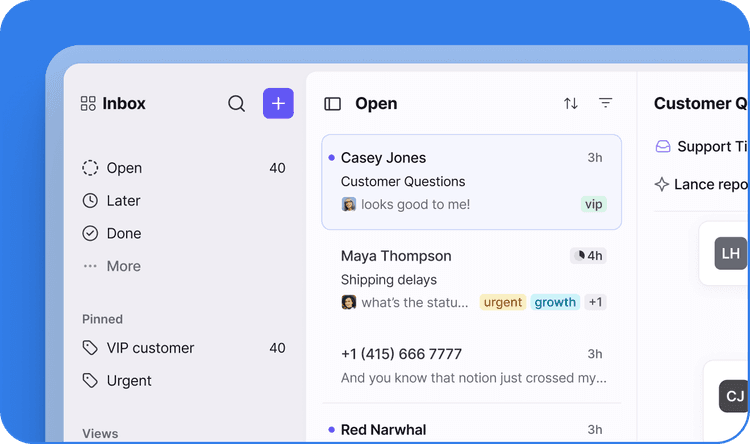
Front is a customer operations platform, not just a traditional help desk. Its conversation-first approach organizes work around conversation threads, so teams can easily see the full conversation history as they respond to customers. Team members can also collaborate using features like internal notes and automate routing. Front works well when support depends on shared context, clear ownership, SLAs, internal collaboration, and follow-through across teams.
Zendesk: For large teams that want traditional ticket-first support
Zendesk is suited to support teams in large companies that are looking for a conventional ticketing system to manage high volumes of simple queries.
Because Zendesk offers highly customizable ticket management, AI automation tools, analytics features, and routing, large support organizations can stay organized as volumes increase.
Help Scout: For smaller SaaS teams that want simple customer support software
For support teams in small to midsized companies, Help Scout is simple and easy to use. Support teams can reply to customers via Help Scout’s intuitive shared inbox, while accessing the company’s knowledge base and the full conversation history. Help Scout reviewers often highlight its simple interface.
Jira Service Management: For technical and developer-heavy workflows
Jira Service Management works well for IT and technical support teams looking for a ticketing system geared to developer workflows.
Jira’s system has web forms and templates for troubleshooting technical issues and managing incidents. It also integrates well with other Atlassian products like Jira Project Management and Confluence, making it ideal for IT service management.
HubSpot Service Hub: For teams already using HubSpot CRM
For growing companies that want to integrate customer support with marketing and sales, HubSpot Service Hub stands out.
HubSpot’s ticketing system connects support tickets with CRM data, giving support teams full access to customer context. Companies already using HubSpot CRM can expect to have an easy integration process.
How to choose between ticket-first and conversation-first support
Front’s Coordination Tax report found that only 5% of companies see the complete picture across handoffs, coordination time, and duplicate work within their workflows.
For ticketing systems, that gap usually shows up the same way: A tool shows you ticket status, but not how the conversation moved between departments to get there.That’s the main difference between the two types of ticketing software, ticket-first or conversation-first. The best choice depends on your operating model.
Ticket-first support works when requests are simple and queue-based
A ticket-first system like Zendesk is built to create and manage tickets. Every request becomes a ticket that moves through a structured workflow from intake to close, with clear status tracking at every step.
This model fits technical support teams and small SaaS companies handling requests that they’re able to resolve quickly with minimal handoffs.
Conversation-first support works when context and coordination matter
A conversation-first approach like Front organizes work around conversations, not tickets. Messages stay connected in threads, preserving continuity so interactions feel like an ongoing conversation instead of a series of disconnected tickets. Teams collaborate directly inside those conversations with internal comments and assignments.
Conversation-first support is ideal as companies grow and SaaS support requires more collaboration. When issues depend on account history, product context, engineering input, SLA requirements, or customer success follow-up, the system needs to preserve the work around the ticket, not just the ticket itself.
Front keeps SaaS ticketing systems connected to the work behind every conversation
Hootsuite’s EMEA Customer Success team previously relied on a Zendesk-centered workflow and standard email support. The team lacked visibility into who was handling what, and coordinated updates manually through Slack.
After switching to Front’s customer operations platform, Hootsuite’s three customer success teams can now collaborate, escalate issues, and assign clear ownership, all from a single platform. They now manage more than 2,000 customers with better productivity and far less risk of a message falling through the cracks — proof that B2B SaaS teams need a platform that keeps conversations connected, not just a system that tracks tickets.
Front brings assignments, internal comments, SLA management, automation, and integrations into one workspace, so teams can assign ownership, escalate, and follow up with customers without leaving the platform.
See how teams use Front stay organized amid high volumes of work. Book a demo today.
FAQ
Can a SaaS ticketing system help reduce churn?
Yes, a ticketing system helps teams manage tickets and respond quickly. Quick resolutions can boost customers’ satisfaction and improve retention.
How long does it take to implement a SaaS ticketing system?
It depends on the size of your company and the complexity of your setup, but most systems can be up and running in a few weeks. Read Front’s onboarding guide to get a sense of what’s involved in the setup.
How does a knowledge base support a SaaS ticketing system?
A knowledge base gives customers instant answers, so they can resolve their own issues and don’t need to open a support ticket. It also gives your support team access to reliable information to use in their replies.