



See how omnichannel personalization helps B2B teams deliver consistent customer experiences by connecting conversations and context across every channel.
A financial-services executive emails a loan request to an account manager. Then, the client’s finance team follows up on the request via Slack. To answer well, the support team needs to connect the two messages, pulling details from the original email into the Slack reply.
That’s omnichannel personalization in action. It goes beyond tailoring individual messages or sending marketing messages via multiple channels — it’s about connecting context from different stakeholders across channels and systems, so the customer gets one consistent experience.
That’s hard to pull off, especially in B2B, where conversations and data are scattered across teams and channels. Front’s Coordination Tax report found that 64% of companies experienced at least one customer-facing coordination failure in the past three months.
This article covers what omnichannel personalization is and the practical ways B2B teams tighten coordination to deliver consistent, personalized experiences.
Personalization works best when every channel shares the same customer context
In B2B customer service, omnichannel support is the norm. Customers reach out via email, live chat, phone, Slack, Microsoft Teams, and customer portals, and support teams have to coordinate responses with finance, operations, customer success, and other teams.
Take a logistics customer who requests a shipment update through live chat after previously emailing support. The support team, dispatch, and account managers all need the same shipment context to give consistent cross-channel responses.
AI customer service tools help teams access information more efficiently and deliver more consistent responses, but they’re only effective when they have access to connected customer context. As Neal Travis, Head of Customer Experience at AIHR, said in Front’s State of Service Expectations report, “Even with the way that AI is shaping service delivery today, customers’ non-negotiables haven’t changed. They want accessible, accurate, and effective support. AI can make or break that experience.”
The key to effective omnichannel personalization is making customer context readily available across all touchpoints in the customer lifecycle.
How B2B teams deliver personalized customer experiences across channels
French Side Travel offers an example of omnichannel personalization that shows both the promise and the difficulty. The company can spend up to a year planning trips for its clients, but managing 12 months of conversations across email, phone, WhatsApp, and social media made it difficult to keep track of customer context. As the team grew, agents spent increasingly more time searching for past messages to deliver the personalized service customers expected, and clients kept having to repeat themselves.
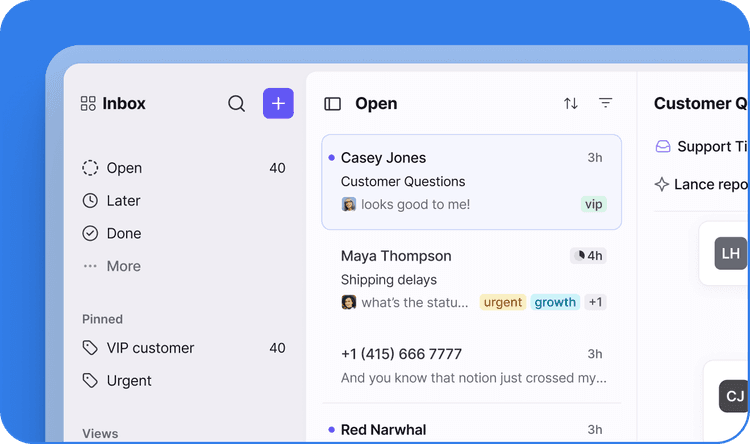
The fix was to centralize communication in a shared inbox on Front. Now the team sees the full conversation history and account details at a glance and can respond in a way that references each client’s plans, bookings, preferences, and past requests. Less time reassembling the past, more time personalizing in the moment. Here’s how to get there.
Keep every customer conversation connected
If your team uses Gmail for email support, Slack for real-time messaging, and a separate app for in-app chat, connecting an issue across those three silos is a slog. Customers re-explain in Slack what they already said over email, and the service stops feeling personal.
Use an omnichannel personalization platform that pulls every channel into a unified workspace and lets your team reply without switching apps. This makes it much easier for them to connect a customer’s latest email with an earlier Slack thread and use that context to provide a personalized response.
Give every team the same customer context
When you’ve connected conversations across channels, the next step is to make that context available to every team touching the issue. B2B issues cross teams constantly, and no team can deliver consistent, personalized service without reliable access to the full conversation history and the latest updates.
When a manufacturing client reports a production defect via email and then escalates on Slack, operations, support, and customer success have to coordinate the fix and keep various stakeholders informed. Doing so requires a shared view of the issue’s history and current status.
Personalize every interaction, not every channel
Personalizing each channel in isolation isn’t enough. Customers start on one channel and continue on another, and they expect you to connect the dots. Make them start over and the personalized experience falls apart.
That’s the line between omnichannel and multichannel. Multichannel personalization means good service on several channels that don’t talk to each other; a true omnichannel strategy treats cross-channel interactions as one conversation, with full continuity as it moves from email to Slack to chat.
Turn customer insights into better experiences
Treat every interaction as a chance to learn. Capture a customer’s pain points, priorities, communication preferences, and behavior changes, and add them to a profile your team can pull up next time.
For example, a software customer emails you about an integration problem. Your support team quickly resolves the issue, but they notice it’s the third time the customer has asked something similar. They ask the product team to write a knowledge base article on the fix, so the next integration issue resolves faster. And because the customer prefers email, they send the link that way when it’s live.
Great personalization improves customer operations, not just customer experiences
Front’s Coordination Tax report found the typical B2B company spends nearly three hours coordinating for every hour spent solving customer problems. Improving omnichannel personalization means connecting context across channels, which is exactly what eats those coordination hours. Get it right and you win that time back, with operational gains like these:
Faster issue resolution: With integrated context, teams spend less time hunting for information and more time solving problems.
Stronger cross-functional collaboration: Shared access to customer data helps teams coordinate work more efficiently.
More consistent customer communication: The work of personalizing conversations across channels also makes them more consistent, which lifts customer satisfaction.
Better relationship management: With a full view of the customer journey, teams manage relationships better and strengthen retention.
How AI supports omnichannel personalization
As Front’s Head of AI, Kevin Yang, said in the State of Service Expectations report, “AI should be used strategically to augment, not replace, customer service teams. Customers still value human connection and often turn to humans first when they want high-quality service.”
Here’s how AI can help you deliver large-scale omnichannel personalization (with human-first interactions always still in mind!):
Find relevant context: Before teams respond, they can use an AI assistant to summarize the issue automatically and search for context more quickly.
Identify customer preferences: Use AI to analyze large amounts of customer data, spot trends and behavior changes, and recommend ways to tailor your messaging.
Draft faster responses: Let AI help draft and personalize responses while your team stays in control, reviewing every output before it goes to the client.
Automate routine work: Point AI at common questions and tasks like routing and escalation, and you free your team to focus on engagement and personalized service.
Omnichannel personalization runs on connected conversations with Front
When Seso relied on a patchwork of disconnected tools like Gmail, Slack, and RingCentral, its customer success managers (CSMs) struggled to give clients personalized service. Important customer context was buried deep in personal inboxes or old Slack threads, so no one could see the full picture.
With Front, Seso now has a unified omnichannel workspace where teams see customer conversations alongside account history through a Salesforce CRM integration. That shared context means CSMs spend less time searching and more time on their customers.
“People are calmer, more focused, and we’re trending toward inbox zero,” says Ben Terrill, Seso’s Head of Customer Success. “The folks who’ve adopted Front are really positive. They’re able to focus on more of our customers, which is the end goal.”
Seso’s challenge is common across B2B teams. Front’s Coordination Tax report found that only one in seven companies spends more time solving issues than coordinating.
Front’s customer operations platform helps reduce coordination time and offer better, more personalized service by giving teams shared access to multichannel customer conversations and account data in a single workspace.
Book a demo to see how Front can help your team provide personalized customer experiences as customer operations grow.
FAQ
How do you measure the success of omnichannel personalization?
Track customer satisfaction and ensure that it’s consistent for every channel you use. Also, use your analytics dashboard to track response and resolution times as work moves across teams, so you can find places in the handoff workflow where context gets lost.
Does omnichannel personalization require a customer data platform?
No. A customer data platform can help bring customer data together and personalize responses, but it’s not a prerequisite. The best omnichannel personalization software to use is a customer operations platform that gives teams a shared view of customer context.
What challenges do B2B organizations face when implementing omnichannel personalization?
The biggest challenges are connecting context across multiple channels, coordinating responses consistently, and achieving shared visibility for multiple teams working on customer conversations.