



Explore customer feedback software for B2B teams. Compare leading tools for collecting, analyzing, and acting on customer feedback.
Collecting customer feedback is the easy part — almost every tool on the market does that well now. What most don’t do is get that feedback to the right owner before it goes stale.
In B2B, feedback shows up everywhere: survey responses, support conversations, website behavior, and account notes, and it’s rarely one team’s job to make sense of all of it. Front’s Coordination Tax report found that 64% of B2B companies experienced at least one customer-facing coordination failure in the past three months. Feedback that never reaches the right owner is one of the most common versions of that failure. It’s a real signal, sitting in a channel nobody’s checking, until it’s a churn risk instead of a fixable issue.
This guide covers what customer feedback software needs to do for a B2B team, then compares 10 tools by the job each one is built for.
What customer feedback software needs to do
Most feedback tools can collect different types of customer feedback and are good at capturing input. Fewer are good at making sure that input reaches someone who can act on it. Four things matter most.
Make it easy for customers to provide feedback
A tool with 50 survey templates doesn’t help if customers abandon the form halfway through. Prioritize an easy, low-friction experience across whatever channel the customer is already using. AI-assisted tools that mine existing support conversations can surface signal your team never explicitly asked for — feedback customers gave without filling out a form.
Show trends, not just comments
Reading individual survey responses doesn’t scale. You need a real analytics layer: CSAT, CES, and NPS, tracked over time, that turns a pile of comments into a pattern you can act on before it escalates.
Segment by what actually matters
An overall satisfaction score tells you less than a score broken down by account type, issue category, or workflow. Your analytics product needs to slice the data that way, not just report on an average. Segmentation turns “customers are unhappy" into “this specific account type hits this specific wall.”
Connect to your workflow
A tool that stores feedback somewhere separate from your customer support operations disconnects it from the people who’d actually know what to do with it. The best tools tell you where feedback came from, who owns it, and where it needs to go.
10 customer feedback tools, grouped by what they’re built for
While a small boutique hotel may require a simple dashboard with lower pricing, a multinational retailer would more likely require in-depth analytics. Compare 10 tools to find the best match for your team’s needs.
Support and customer operations
Support teams see more feedback than anyone; it just doesn’t usually look like feedback. It looks like a ticket, a complaint, or a pattern across a dozen conversations no one’s connected yet. They need a tool that can coordinate high volumes of different insights.
1. Front
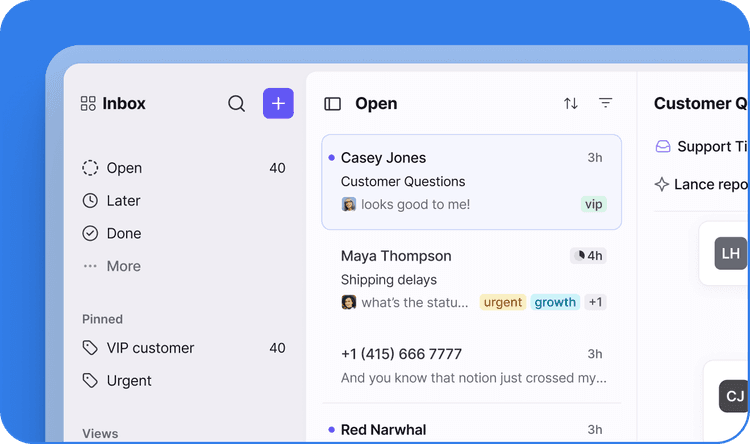
Front analyzes CSAT signals, service conversations, and account-level patterns while keeping the response coordinated across whoever needs to be involved. It fits B2B support and operations teams that need feedback connected to daily conversations, ownership, and workflow — not sitting in a separate reporting tool. Front’s best features are its analytics, workflow automation, and connected customer context, which track every piece of information without losing relevance. It also turns feedback into actionable insight more effectively than a targeted survey design or UX research platform can on its own.
2. TeamSupport
TeamSupport is an AI customer feedback tool that analyzes conversations and generates insights to help you build relationships. It works best for B2B support and customer success teams looking for stronger account intelligence.
While TeamSupport is a full B2B customer support platform, this review focuses specifically on its ability to turn customer conversations into account health insights rather than evaluating its ticketing, help desk, or support workflow capabilities.
Product teams
Product teams need feedback tied to a specific feature, routed to whoever can actually build the fix.
3. Canny
Use Canny to develop a product roadmap by capturing customer insights from support conversations. It’s a good fit for product teams that need to organize feature requests, prioritize them for development, and then close the loop by notifying customers when they’re added.
Canny is specifically a product development tool. You might need other software to evaluate overall satisfaction or measure the customer experience along with it.
4. Usersnap
Usersnap is also aimed at product teams, but instead of analyzing conversations, it collects feedback via in-app surveys and embedded feedback forms. This makes it a great choice for SaaS product teams looking for direct, real-time insights on how the product works and how they can improve it.
Like Canny, Usersnap is strongly focused on product feature development. Use it as a UX research tool, not as a way to track overall sentiment or CX.
Customer surveys and sentiment
Survey tools are usually the fastest way to just ask customers how they feel, often with a workable free tier.
5. SurveyMonkey
SurveyMonkey claims to be “the world’s most popular survey platform,” and people agree. It’s used by 260,000+ organizations. SurveyMonkey can help you create any kind of online survey, from product analytics to a voice of the customer survey. However, it doesn’t offer many analytics tools, so it’s best for simply collecting information.
6. Typeform
Typeform takes a visually engaging, conversational approach to customer surveys. Instead of a long list of questions, many of its survey templates give customers one question at a time, making it easier to give feedback and boosting response rates. This makes it a good choice for teams looking to collect a broad range of different types of feedback without overwhelming customers.
Website and user feedback
Your website already provides valuable insights. These tools capture it without asking the customer to do anything extra.
7. Hotjar
Hotjar differentiates itself by giving visual feedback, with heatmaps that show you exactly where users click and scroll as they navigate your website or app. It’s a great option for UX research teams at SaaS companies because it helps them visualize exactly how customers use a product and where they hit barriers or pain points.
Although Hotjar does offer survey templates, it’s best to use it primarily to see specific user behavior, not to understand overall sentiment or satisfaction.
8. Userback
Userback is also focused on website use, but it uses embedded surveys and widgets to collect bug reports and qualitative feedback in addition to visual feedback. This makes it a good fit for dev, QA, and product teams at SaaS companies. Just keep in mind that it’s a specialized UX research tool instead of a general-purpose platform.
Enterprise feedback programs
At real scale, feedback needs infrastructure built for volume and complexity and a budget to match.
9. Qualtrics
Qualtrics is well-known for enterprise-scale CX management. With its powerful surveys and detailed metrics, it’s a good choice for enterprises trying to measure and improve CX across a large customer base. But before choosing Qualtrics, verify whether you have the scale to make the platform’s expense and complexity worthwhile.
10. Medallia
Medallia is also an enterprise CX tool, but it positions itself more as a way to “turn experience data into meaningful impact.” Try it if you want a sophisticated research tool that integrates customer feedback into your day-to-day enterprise support operations.
Benefits of adding customer feedback software to your workflow
Get how to track customer feedback right, and the right tools turn that consistency into real, measurable impact.
Clearer visibility into customer needs
Feedback tells you what to fix and what to build next, but only if someone’s actually looking at the pattern, not just the individual comment. The right software helps bring recurring themes to light, whether many customers are pleased with shipping time or frustrated with a common bug during checkout.
Better prioritization of customer issues
When you collect feedback at scale and organize it clearly, you see which requests are most popular and can prioritize them. This way, you avoid spending time on low-impact issues that only affect a few customers.
Real coordination, not just visibility
Shared feedback access lets product, success, and operations agree on ownership and next steps, turning feedback into a positive feedback loop instead of a vague signal everyone’s aware of and no one’s accountable for.
Front keeps feedback moving forward
Software can collect data for you. Understanding the context and acting on that data is where some teams fall short.
Front connects feedback to the conversations where customer work already happens, so acting on it doesn’t mean switching tools or reconstructing context from scratch. It helped Reed & Mackay improve operational visibility, exceed client SLAs, and reach 97% CSAT.
Book a demo to see how Front connects client conversations, performance insights, and follow-up work.
FAQ
How do you choose the right customer feedback software?
Evaluate options based on your team structure, feedback volume, operational complexity, and follow-up requirements.
How do NPS, CSAT, and CES measure different parts of the customer experience?
NPS measures overall loyalty, CSAT measures satisfaction with a single interaction, and CES measures how much effort it took to get something done. None of them replaces the other two.
How can B2B teams prove the ROI of customer feedback software?
Collecting feedback is only the first step. To demonstrate ROI, use customer insights to improve operations and customer experiences, then track the resulting improvements in retention, satisfaction, and revenue.