



Learn how to talk with customers in B2B environments with clear, structured communication that improves response quality and long-term relationships.
In B2B, communication is the line between a customer who trusts your process and one who starts questioning it. Strong communication builds trust; weak communication creates friction across teams and timelines.
And the margin is thin. When multiple stakeholders are involved, one unclear update, one missing detail, one delayed response can spiral into confusion that derails expectations and strains the long-term relationships you can least afford to lose.
This guide lays out how to talk with customers so you stay in control of conversations across complex workflows.
What makes customer communication different in B2B
B2B customer communication carries more weight than B2C, and for a simple reason: You’re never talking to just one person.
You’re managing internal and external stakeholders who each have their own priorities. The relationships run for months or years, so every message has to reflect the full account context — contract terms, past conversations, service-level agreements (SLAs). And holding that clarity takes coordination across channels and departments, which only gets harder as you grow.
The cost shows up in the numbers. Front’s research found that B2B teams spend nearly three hours coordinating customer requests for every hour they spend actually solving them. That’s how much effort goes into just keeping communication aligned.
How to communicate with customers: 4 B2B principles for effectiveness
B2C communication leans on interpersonal skills, like active listening and positive language in customer service. In B2B, the stakes climb: Every decision affects systems, revenue, and relationships that are far more intertwined and expensive than in B2C.
Effective customer communication relies on four principles:
Clarity over completeness: Keep messages brief, solution-focused, and in plain language, structured in short paragraphs the reader can move through fast.
Context matters: Pull the account history and restate the relevant context from prior conversations, so the customer knows you actually understand their situation.
Clear accountability: Take ownership of the next steps, set timeline expectations for resolution, and give updates whenever you hand off or escalate an issue.
Consistency across touchpoints: Align your messaging so customers get one answer, not conflicting updates from different teams and channels.
Structuring customer conversations: From opening to closing
Whatever the channel, customer communication should be clear, concise, and professional. Here’s a simple structure you can apply across channels, along with sample customer service keywords and phrases to use at each stage.
Opening
Anchor the conversation in context right away, so the customer knows the purpose of the message the moment they open it. Acknowledge their specific request or reference a prior interaction to show you’re already up to speed.
Example: “Following up on your request about [X] from yesterday…”
Next, define the precise scope of this interaction.
Example: “In this update, I’ll cover the current status and next steps.”
Own the next step — or identify the person responsible for the next update — and give the customer a clear timeline so they know exactly when to expect progress.
Example: “You can expect the next update by [time/date], and I’ll be your point of contact.”
Middle
The body of the message should explain how your team is handling the issue. Provide enough context as you go so the customer is always clear about the status.
Example: “As a reminder, this depends on [team/process], which is currently in progress.”
Since B2B issues often involve multiple teams, make ownership visible by specifying who is doing what.
Example: “Our team is handling [X], while [Team Y] is responsible for [Y].”
This is also the right time to ask targeted clarifying questions and collect any missing information, avoiding unnecessary back-and-forth.
Example: “To move this forward, could you confirm [specific detail]?”
Closing
Close by laying out the next steps and confirming you’re aligned.
Example: “Next, we’ll [action], and you’ll hear back from us by [time]. Let me know if this aligns with your expectations.”
Confirm that you’ve documented the outcomes in the support ticket.
Example: “I’ve documented this update so all stakeholders have visibility.”
Finally, sign off with a simple promise to keep the customer informed.
Example: “If anything changes, I’ll update this thread directly.”
Treat these examples as repeatable patterns, not a rigid script. B2B communication isn’t about using a list of canned best customer service comments. It’s about creating the right operational setup to support complex, multi-stakeholder interactions.
B2B customer service communication examples
Strong B2B communication runs on real-time collaboration: the internal alignment that keeps every team working from the same version of the truth.
But Front’s Coordination Tax report found that 42% of companies don’t track coordination at all, meaning teams have no way to see where context gets lost or where execution starts to slip.
In B2B, when internal alignment is weak, communication fractures, and even routine issues turn into relationship risks. The examples below show how the same moment can protect or damage customer relationships, depending on the coordination behind it.
When delays happen, communication decides whether trust holds
A logistics company needs to notify an important customer about a shipping delay. Support gives one estimated resolution time, and operations give another. Neither team is wrong. They’re just working from different pieces of the story. The customer isn’t frustrated by the delay itself; they’re frustrated because the company can’t provide a single reliable answer.
This is inevitable when teams don’t share the same real-time information. Without a unified system, every update becomes an interpretation instead of a fact. The fix isn’t more messaging — it’s shared context.
When customer-facing teams work from the same information, delays stop turning into trust issues. The customer gets one clear update, the issue resolves cleanly, and the relationship stays intact.
When multiple stakeholders are involved, communication prevents escalation
A financial services company is onboarding a major new customer. Support is working with the primary client contact to gather documentation and approvals. Meanwhile, an executive who’s unaware of the holdup calls the account manager to complain about the slow onboarding. The relationship is strained before the partnership even begins.
This isn’t a messaging problem; it’s a coordination problem. Multi-stakeholder accounts break down when communication doesn’t reach the people who need it. A proactive update would have kept that executive aligned on status and blockers and prevented the escalation entirely.
Proactive, personalized updates keep stakeholders aligned and stop confusion from turning into escalation.
When you follow up, communication uncovers issues before they spread
A support team launches a new AI chatbot to handle simple queries. The launch email is unclear, and some customers assume the bot replaces the support team entirely. When it can’t crack their complex questions, those customers don’t reach out — and the problem stays invisible.
That’s how a small misunderstanding becomes a blind spot when nobody follows up. The issue isn’t only the wording of the original email; it’s the missing check-in. Without one, the team never learns that customers are operating on a false assumption. A single follow-up would have surfaced the confusion immediately, reopened the conversation, and pulled in valuable feedback. Build reminders and automated workflows so follow-ups happen every time and problems get caught early.
When priorities shift, communication keeps expectations aligned
A manufacturing company grows quickly and takes on more customers. Response times to existing accounts slip as teams pour energy into onboarding. Internally, everything looks fine — SLA targets are still green. But the slower responses make long-time customers feel overlooked, and without a word of explanation, frustration builds until some start questioning whether to renew.
Proactive communication is what closes that gap. Without it, the company reads SLA compliance as satisfaction while customers read slower responses as neglect. A simple heads-up about the slower response times would have explained the change, surfaced concerns early, and let the company protect its original standard of service.
Talk with customers with clarity and control — with Front
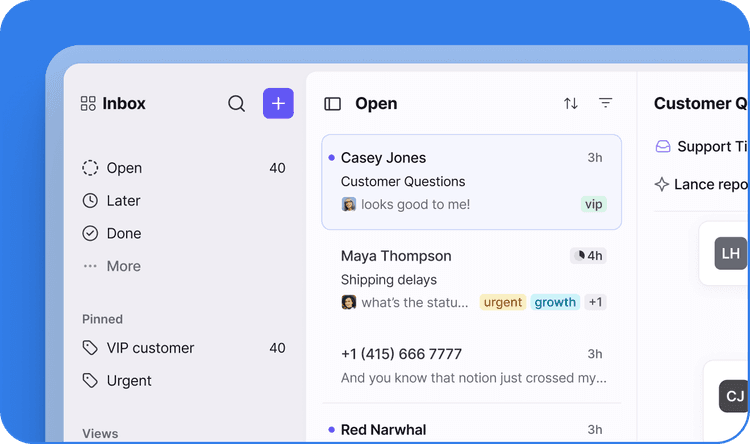
B2B customer communication breaks down when conversations are scattered across teams and tools. To deliver consistent, reliable answers, teams need visibility, coordination, and shared context in one place.
Front is that place. It keeps every team, tool, and customer conversation in sync across channels and touchpoints, so ownership stays clear, cross-team collaboration gets easier, and workflow automation handles high-volume, high-context communication without anyone losing control.
Watch this webinar to see how Front connects real-time conversations to the rest of your operation.
FAQ
What role does follow-up play in customer communication?
Follow-ups help confirm that customers are satisfied with the resolution and give teams an opportunity to address any remaining questions or concerns. Use automated follow-ups (such as customer satisfaction surveys) to gather feedback at scale, and add personal check-ins for high-value accounts.
How do B2B teams choose the right tools for managing complex customer communication?
Start with an omnichannel support platform that centralizes messages from live chat, email, Slack, and Microsoft Teams and connects to your CRM so the full relationship context sits alongside the conversation. Add self-service resources like knowledge bases and FAQs so customers can resolve common questions on their own.
How can AI improve or influence customer communication?
AI tools help teams respond more consistently and efficiently by summarizing conversations, highlighting relevant context, and drafting or refining responses. By taking the manual work off the team, AI lets them respond faster while maintaining accuracy and a consistent customer experience.