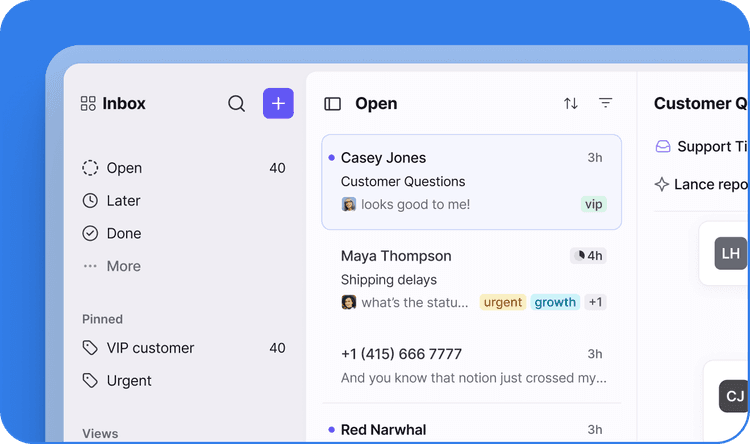




Discover what inbox zero means, how it works, and how B2B teams can use this approach to organize customer conversations, improve ownership, and keep work moving.
In a customer-facing team, emails never stop. Priorities shift, new issues emerge, and even the tidiest inbox fills back up before the day ends.
That’s the appeal of inbox zero: a sense of control in a space that’s hard to stay on top of. But an empty inbox was never the point. The real value is knowing which messages need attention, which can wait, and which are already done. Without that, inbox zero just trades one pile for another.
This article covers what email inbox zero means, when it helps, and how B2B teams use it to build lasting clarity instead of temporary tidiness.
What is inbox zero for customer conversations?
Inbox zero is an email management method focused on processing messages through a set of clear actions: replying, deleting, archiving, delegating, or deferring.
Five principles guide it:
Not all emails are important.
Your time is valuable and limited.
Shorter responses work better.
Don’t feel guilty about a full inbox.
Be honest about your priorities and capacity.
Despite the name, the goal of the inbox zero method isn’t an empty inbox. It’s knowing which messages require attention. An empty inbox is great for a minute; the real win is a system of consistent actions and tagging that keeps the inbox honest.
Why inbox zero breaks down in customer-facing work
In personal email, inbox zero can feel like a treadmill: Messages pile up while you’re heads-down on a project, and you’re stuck between unfinished work and an inbox you’ll never fully clear.
Customer-facing B2B inboxes raise the difficulty. These aren’t just messages — each one represents a customer need: a request, a follow-up, an escalation, or a task that pulls in multiple teams.
That’s why inbox zero works better as a workflow checkpoint than a literal empty inbox. It shows what needs attention, what’s resolved, and what has a clear next step. Success gets measured in workflow clarity, not message count.
How to clear the inbox without losing context or ownership
“How do I get to inbox zero?” is the wrong question. Here’s a better one: “How can I clear the inbox without losing context, ownership, or follow-through?” What matters most is managing inboxes while customers continue to receive timely, informed responses.
1. Give every conversation a clear next step
The classic inbox zero method asks you to decide, for every message, whether to handle, defer, delegate, or archive it. In a shared inbox, that only works when every conversation has a visible owner and a defined next step.
Imagine a customer reports an issue with their latest shipment. A support rep confirms the order but needs dispatch to investigate the delay. Instead of letting the email sit in a general inbox, the rep delegates it to the dispatch coordinator, tags it “waiting for dispatch,” and sets a follow-up for the next morning.
Now, the entire team can see who owns the issue, why it’s unresolved, and when action is expected. Anyone opening the thread instantly understands the status — no guesswork, no duplicate replies.
2. Use rules to route the right work to the right team
Rules, labels, filters, and automation sort conversations upfront, before anyone reviews them by hand. The aim isn’t full automation — it’s smarter triage that gets the right work to the right specialists.
Billing emails mentioning invoices or failed payments drop into the finance queue. Shipping notes about delivery delays go straight to logistics.
That keeps the shared inbox from turning into a dumping ground. Work flows to the people best equipped to handle it, and customers reach the right team sooner. This means faster responses and less internal back-and-forth.
3. Keep context attached to the conversation
Customer conversations often stall because context gets scattered. A support representative asks a question in Slack, the account manager replies in Teams, and someone else leaves notes in a CRM. When it’s time to answer the customer, the information is fragmented and hard to reconstruct.
The fix is simple: Keep internal coordination connected to the customer thread.
Say a customer asks why their renewal invoice differs from last quarter. The rep pings finance with an internal note. Finance replies in the same thread with the updated contract details. The account manager confirms the commercial terms — all before the customer hears back. Anyone who opens the thread later gets the whole picture instantly, no digging through chat history or asking around.
4. Batch low-priority work so urgent issues move first
Inbox zero doesn’t mean responding to every email right away. Treating all messages as urgent multiplies interruptions and slows teams down. Group conversations by urgency and customer impact.
A logistics team might clear delivery confirmation requests twice a day, since they rarely need immediate action, while active shipping delays and service outages sit in a high-priority queue that’s watched continuously.
Batching cuts context-switching and keeps admin work from crowding out critical issues. Urgent inquiries get faster answers, and teams stay focused on what matters most.
5. Archive only when the work is resolved or clearly owned elsewhere
Archiving shouldn’t mean “I’m done looking at this.” It should mean the issue is resolved, no action is needed, or ownership has clearly moved to someone else.
Say a customer sends a billing question finance needs to dig into. Support shouldn’t archive it just because they forwarded it along. The thread stays active until finance takes ownership, the customer gets an update, or the issue is fully resolved.
When you archive based on completed work rather than a tidy-looking inbox, every conversation left in the inbox represents active customer work — while every archived thread is genuinely done or clearly someone else’s responsibility.
Bring inbox clarity to customer conversations with Front
When conversations live across disconnected tools, work slips through the cracks. Emails slip, service-level agreements get missed, and complexity grows faster than the systems meant to manage it.
Column, the first collaborative public notice platform, hit exactly this. As it grew, email became the bottleneck. The team spent more time coordinating across platforms than helping customers, and backlogs stacked up.
They needed a unified customer operations platform, and they chose Front. Front pulled conversations from every channel into one workspace, giving teammates a shared place to collaborate through threaded comments. Column built 32 dedicated inboxes for specific customers and centralized everything in one system, where Front’s automation rules made workflows easier to follow and information easier to find.
Within 30 days, Column tripled its efficiency and reached inbox zero. But Front did more than connect conversations — it helped Column build a system tailored to the way its team works.
“We’ve gone eight months without backlog issues — something we’d never experienced before Front. Our team has matured and improved, and now we have a much better system to organize our work and operate more efficiently,” says Deidre Stevens-DiGiovanni, senior customer support manager at Column.
Request a Front demo today to see how the platform creates inbox clarity while keeping conversations visible, accountable, and moving forward.