



Learn how customer experience automation works in B2B, where it fits, and how to implement it at scale without losing visibility or control.
Picture this: A long-standing customer is preparing to expand their contract. Over the previous year, they interacted with sales, onboarding specialists, product experts, and customer success managers. Then renewal talks open — and everyone realizes the critical details are scattered across systems.
Support teams can’t see recent commitments, success managers don’t have visibility into open cases, and sales lacks context from onboarding. The customer ends up repeating things they’ve already said, and what should feel like an ongoing relationship starts to feel like starting over.
CX automation is what makes coordination possible at scale. This guide covers where automation fits across the customer journey, which approaches move the needle, the pitfalls to dodge, and how to automate without compromising the CX.
What is customer experience automation?
CX automation uses AI, machine learning, data, and automated workflows to deliver personalized and fast support at scale. Plenty of teams reduce it to auto-replies or chatbots, but real CX automation spans the whole lifecycle, from onboarding to renewals and feedback loops.
There’s a related mix-up worth clearing up: orchestration versus task automation. Task automation handles individual, repetitive actions. Orchestration uses customer data to string those tasks into end-to-end workflows.
Task automation might create a customer account the moment a contract is signed. Orchestration triggers the whole coordinated onboarding flow when the deal closes: Sales hands off requirements, implementation schedules kickoff and configures the platform, and support inherits the account context and success plan.
Where automation fits in B2B CX: Key applications
In B2B, CX automation keeps the customer journey smooth by moving people and data across systems. It shows up in:
Customer onboarding and activation: Coordinate welcome communications, account setup, training, and implementation milestones to get customers up and running faster.
Ongoing communication and engagement: Send the right updates and check-ins at the right time based on customer activity and lifecycle stage.
Cross-team coordination and handoffs: Keep customer context flowing easily between sales, implementation, customer success, and support to prevent friction during transitions.
Feedback and retention workflows: Trigger surveys, identify churn risk early, and launch retention workflows before problems grow.
The thread running through all of it is continuity. Instead of automating tasks in isolation, CX automation builds one connected experience that carries a customer from first touch through adoption, growth, and long-term success.
How to implement CX automation without losing control
Good CX automation starts from real customer needs. Here are four ways to roll it out without giving up control where it counts.
1. Map the customer journey and find the repeatable patterns
The biggest mistake companies make with CX automation is automating before they understand the journey they already have. Before you add a workflow or an AI-powered tool, map how customers move through the lifecycle, from first contact with sales to expansion.
Watch for the repeating moments: Where are teams doing the same task over and over? Which interactions follow a predictable path? Those moments are your best automation candidates; you can standardize them without hurting the experience.
2. Start with high-volume, low-risk touchpoints
Not everything should be automated on day one. Automate the repetitive, high-volume, low-risk tasks first — things like routing messages and ticket categorization, where automation helps right away and a mistake costs little. Automating those frees your team from admin while cutting delays and inconsistencies.
Starting small also lets you test, gather feedback, and refine before you point automation at anything sensitive or strategic.
3. Layer automation across the lifecycle, not in silos
Automate one department at a time and you’ll often just build new silos — support automates ticket handling while customer success runs onboarding through a totally separate process.
It’s better to layer automation across the lifecycle so context travels with the customer. When sales insight flows into onboarding, customers ramp faster. When support interactions inform customer success, teams catch risks and opportunities early. The experience gets more connected on both sides.
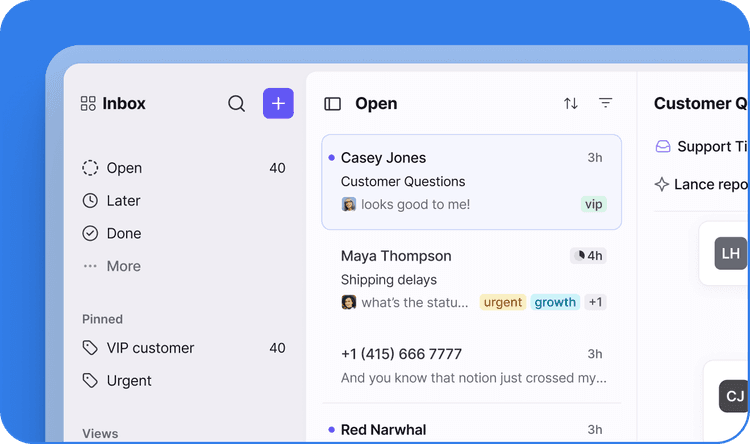
Front’s workflows put this into practice, organizing inbound messages and routing conversations to the right team automatically — so teams stay fast without losing visibility across departments.
4. Measure performance across the whole journey
Automation should make the CX easier to manage, which means measuring beyond department-level metrics. Track the operational indicators — response times, resolution rates — and monitor customer-focused outcomes, like onboarding completion and retention. Looking across the full lifecycle is how you spot coordination breakdowns and see where automation needs tuning.
Done right, CX automation adds control rather than removing it: The workflows improve visibility and pull cross-functional teams into alignment.
The role of AI in CX automation
AI tempts companies to automate everything now and ask questions later, but you don’t win CX on automation alone.
The smarter play is selective: Let AI handle the repetitive tasks — categorizing interactions, summarizing threads — while people bring the context, empathy, and judgment customers still expect. That human element matters most in nuanced conversations, because automation can speed up a decision without understanding the whole story.
AI might see high usage and flag a renewal opportunity; the account manager knows an unresolved support issue means the timing is wrong. Well-managed CX automation supports the team instead of replacing it, and fully autonomous handling works best when kept limited to predictable, low-risk scenarios.
Keep customer experience automation connected and in control with Front
Adding automation isn’t the multi-week project it used to be. Teams can deploy AI and automate tasks in a fraction of the time. The hard part now is keeping it all aligned. As automation spreads across channels and systems, many organizations end up with disconnected workflows that add more friction than they remove. Automation only improves CX when it connects teams and interactions into one consistent experience.
Front is built for that coordination. Instead of piling on another tool, Front brings automation, communication, and collaboration into a single operational layer — combining AI with omnichannel context and human oversight, so teams stay aligned as automation scales. Teams can use:
Autopilot to automate routine customer interactions while keeping full visibility and control for when a human touch is needed.
Workflow automation to standardize processes across the customer lifecycle, so every interaction follows a repeatable path and teams stay coordinated and accountable.
Book a demo today to see how Front keeps automation connected and controlled.
FAQ
Why does customer experience technology fall short in B2B environments?
Most automation tools are designed for simpler, high-volume interactions that are common in business-to-customer settings. But B2B interactions span multiple teams and usually demand continuity and context awareness. Most CX tools fall short because they:
Focus on deflection instead of coordination.
Lose context across interactions and touchpoints.
Introduce AI without clear control or accountability.
The results are costly: lower customer satisfaction and CX that breaks down at scale.
How long does it take to implement customer experience automation?
You don’t need to spend weeks implementing CX automation, especially if you begin small with repetitive tasks across the lifecycle. Today, companies can roll out simple CX automation within days, sometimes even hours. More complex, cross-functional programs may take longer, typically several weeks to a few months.
What are the benefits of customer experience automation?
CX automation does more than just speed up tasks. Here are four ways CX automation helps teams deliver a more connected CX:
Lower cost per interaction through reduced manual work: Using CX automation saves money and lowers cost per interaction, as human reps need to intervene less in routine tasks.
More predictable SLA performance across teams: CX automation handles repetitive tasks and conversations, giving teams more time to focus on complex requests. With data coming from automated tasks, it’s easier to see whether service-level agreements (SLAs) are being met or falling behind.
Clear visibility into operational performance and bottlenecks: Because most of the repetitive work lives inside automated systems, leaders can use data to identify performance patterns and allocate extra support when necessary.
Improved retention and renewal consistency: CX automation improves retention and renewals because it covers the entire customer lifecycle, surfacing risks early and triggering proactive actions to address potential churn.