



A quality assurance scorecard evaluates conversations against clear standards. Explore the criteria you should track for improving service quality.
In B2B customer support environments, quality assurance (QA) isn’t a content exercise. It’s an operations discipline.
According to Front’s Coordination Tax Report, 64% of companies experienced at least one customer-facing coordination failure in the past three months: inconsistent answers, lost context, or customers being asked to repeat themselves. These failures aren’t caused by weak writing. They stem from weak workflows.
That’s why grading individual replies doesn’t move the needle. You need a QA scorecard that helps teams maintain continuity, deliver consistent responses, and improve customer experience.
Here’s what a QA scorecard should measure, and how to build one around the way customer work really happens.
What a quality assurance scorecard measures
A QA scorecard is a structured framework for evaluating customer conversations against criteria like accuracy, tone, resolution quality, and process adherence.
Every organization’s scorecard looks different, but the goal is the same: to evaluate both the quality of the interaction and the operational execution behind it. The most effective customer service QA scorecards in B2B focus on:
Communication quality and customer context: Confirm that responses are clear and accurate and reflect the customer’s actual situation and history, not a representative starting from zero. Tone and professionalism get scored here, too.
Ownership and accountability: Does every conversation have a clear owner? Were handoffs managed with complete context, or did the customer repeat information? Evaluators score whether follow-through happened on time and whether the closing message confirmed next steps.
Cross-functional coordination: Did the conversation move cleanly across support, billing, account management, and operations? Scorecards measure how well context traveled between departments and whether the transitions added friction.
Compliance and process adherence: Did the representative follow the required workflows, scripts, and policies? In regulated industries, the evaluation also covers legal compliance and identity verification.
Resolution quality and customer outcomes: Check whether the problem was solved without unnecessary back-and-forth. Metrics like resolution time and first contact resolution help assess whether the team fully addressed the issue.
Together, these criteria give QA evaluators a consistent way to score conversations.
Great quality assurance looks beyond individual conversations
Only 5% of companies have complete visibility into handoffs, coordination time, and duplicate work. That gap is why so many QA programs produce feedback that feels disconnected from the actual customer experience. Evaluators grade responses without seeing the operational reality behind each one.
Score the whole conversation, not the last reply
QA should assess the entire arc of a customer relationship, not one interaction pulled from the queue. When a logistics client raises a billing dispute that moves through finance and account management before it reaches support, the quality of the experience rides on clear ownership and consistent communication at every handoff. Score only the final reply and you miss all the coordination that made the resolution possible.
Better coaching starts with better operational visibility
QA patterns are far more valuable than individual conversation scores. When the same routing delays or the same confusion around escalation policies show up across multiple support agents, the problem is usually the workflow, not any one person.
Front treats QA as a feedback loop. Representatives see exactly what standard they’re being held to; team leads see the patterns behind the recurring issues. When representatives know what good looks like and managers know why a problem keeps surfacing, coaching gets more consistent and performance climbs.
Calibrate for context and difficulty
Scoring should be consistent across the team while still leaving room for nuance. Evaluators have to weigh customer history and the complexity of the issue.
Set shared criteria as the baseline, then calibrate for difficulty. A routine password reset and a high-stakes contract negotiation shouldn’t receive the same level of scrutiny, even when the same person evaluates both.
QA findings must inform operational improvements
When QA reviewers flag the same escalation delays or missing context in handoffs, those are the processes to fix first. Adjust routing rules and update the documentation your team relies on.
QA data that never leaves the coaching conversation is data that’s only half-used. The real payoff is in the process fix, not the individual note.
Pair internal quality score with customer service metrics, like customer satisfaction (CSAT) and resolution time, and you get a clear read on two different things at once: who needs coaching, and what needs rebuilding.
Build quality assurance scorecards around how customer work happens
Most QA scorecard templates were built for call centers scoring phone calls. B2B organizations managing complex customer support operations need scorecards that reflect how conversations move across teams, systems, and channels.
Measure what drives customer outcomes
Evaluation criteria should reflect the behaviors and practices that improve customer experiences. Your scorecard should measure whether the representative owned the conversation and fully resolved the issue.
Fast responses matter, but accuracy matters more. A fast reply that points the customer in the wrong direction just creates more work for everyone downstream. Score for resolution quality first, speed second.
Keep quality standards consistent
Standardized evaluation criteria remove guesswork, reduce subjective scoring, and give teams a shared understanding of what good looks like. When every evaluator is scoring against the same bar, feedback gets sharper and easier to act on.
Front’s own QA approach leans on exactly this — a predictable standard means representatives spend less time improvising and more time landing the right answer on the first try.
Weight criteria by what moves the needle
Reviewing conversations at scale reveals recurring trends and workflow weak spots that individual reviews miss. If three support agents struggle with the same escalation handoff, the process needs attention.
Check your weighting against real outcomes periodically. A high-scoring conversation that still ends in a repeat contact or an escalation is a sign that your criteria missed something.
Close the loop by tracking whether the fix worked
Scorecard data in B2B should feed directly into coaching sessions and workflow updates.
When five representatives score low on the same escalation criteria, it’s a sign that the escalation workflow needs attention. Focusing solely on coaching individuals won’t fix a broken process. After adjusting the process, track whether the revised workflow reduces escalation-related quality issues in the next review cycle. This closes the loop and confirms that the change improved outcomes.
How AI strengthens quality assurance scorecards
Manual QA reviews typically cover only a fraction of total conversations. AI-powered QA evaluates conversations across email, chat, and phone without losing consistency against your defined standards.
AI improves the reach and impact of QA programs in four ways:
Expands review coverage beyond small samples: Instead of spot-checking a handful of tickets per representative each month, AI customer service software reviews every conversation and flags the ones that need a human evaluator’s attention.
Surfaces coaching opportunities a person would miss: AI uncovers patterns, like repeated compliance misses or skills gaps, that could take a human reviewer weeks to spot across hundreds of conversations.
Connects quality data to the bigger picture: AI-scored quality data combined with customer experience metrics (like CSAT and Net Promoter Score) gives managers a complete view of service quality across the operation.
Focuses coaching where it matters most: Instead of spreading attention evenly, managers can direct it toward the conversations and team members that will move the operation the most.
Front makes your quality assurance scorecard part of the operation, not an audit
Hermes Worldwide runs 24/7 ground transportation operations across multiple departments and time zones. It used to review quality by hand, spot-checking a small sample of emails that never added up to a real picture of communication quality.
With Front’s Smart QA, AI now automatically evaluates every client communication. Managers can assess scores for all team members over any time period, quickly spotting what’s working and zeroing in on conversations that need closer evaluation. The result: time saved and a service standard that holds steady.
To see how QA scoring criteria apply to real conversations, check Front’s QA scorecard guide. It includes QA scorecard examples you can adapt for your own team.
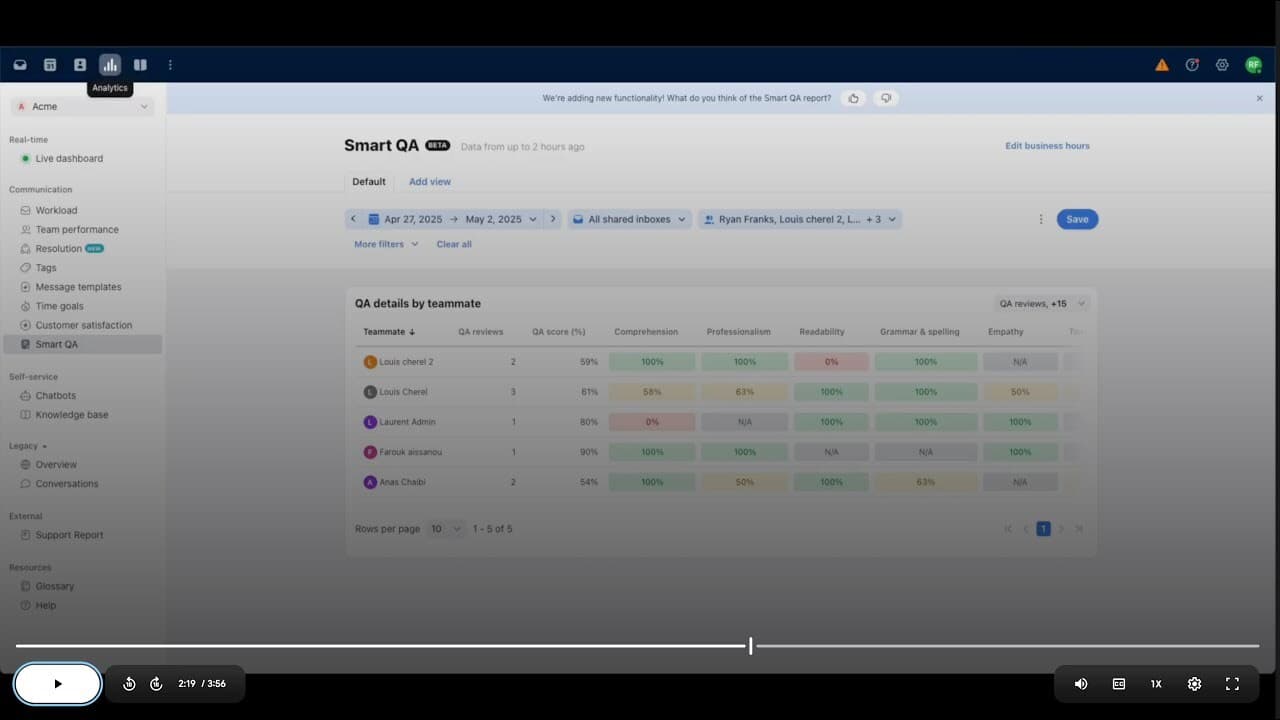
Front keeps every team, tool, and customer conversation in sync, giving QA programs the connected context they need. Try Front’s Smart QA and bring AI-powered quality scoring to your team today.
FAQ
What are some common quality assurance scorecard mistakes?
The most common one: measuring speed without evaluating conversation quality. Teams hit handle-time targets while resolution quality drops and customers circle back with the same issue. Scorecard programs also stop working when organizations treat every interaction identically, or they collect QA data but don’t use the findings to improve the operation.
How often should quality assurance scorecards be updated?
Review scorecard criteria and scoring weights at least quarterly, and revisit them whenever your service standards or customer expectations change significantly. Monthly calibration sessions keep scoring consistent as the team and conversation volume grow.
Who should review customer conversations?
QA programs work best when dedicated QA analysts and team leads both evaluate conversations. Each group brings a different perspective on communication quality and process adherence. Rotating reviewers also reduces individual evaluator bias and gives every reviewer a direct view into how different representatives handle escalations and document customer context.